
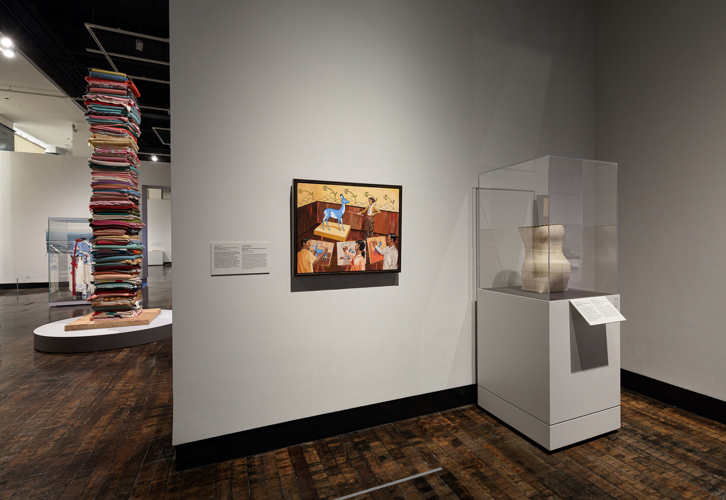

There’s a small painting whose quiet corner you might overlook in the massive, impressive exhibition now on display at the Frist. But its message is loud and clear. “Bambi Makes Some Extra Bucks Modeling at the Studio,” by America Meredith, depicts an instructor as she points sternly to an electric-blue deer in front of a trio of art students at easels. In the peyote ritual practiced by the indigenous people known as the Huichol, the deer represents a traditional narrative of spiritual guidance and ancestral love. It would be easy to see a simple message — a classic “Indian tale” with a moral of listening to ancestors — but the rebellious grins of the students give something away.
The wall text reveals the instructor to be a representation of Dorothy Dunn, a controversial white instructor who sought to promote an “authentic” Native American aesthetic. The style of the blue deer visually references what critics of Dunn derisively referred to as “Bambi style” — a flattened, simplified art style preferred by gallerists as Native experience and expression were commodified for white audiences. So Dunn does indeed teach a lesson, but this one has a darker, more painful moral: For too long, the work of Native artists needed to invoke a certain romanticism that was tangled with preconceptions of what Native tradition is and what it should look like, drenched with the nostalgia of being disconnected from “modern” life. Hearts of Our People: Native Women Artists, on view through Jan. 12 at the Frist Art Museum, does an excellent job at breaking that misconception.
Within Meredith’s image, the Native students smile to each other and make their own work in their own style, ignoring the directives of white whimsy in order to come to the studio as their full selves. Within Hearts of Our People, the artists do the same: They evoke traditional vocabularies of technique and creative practice, while continuing an active and complex conversation through approaches as unique as the cultures represented. The themes of legacy, relationships and power that govern the exhibition address realities of Native American experience, but don’t trap artists underneath an Indian blanket stereotype or force interpretations of particular issues.

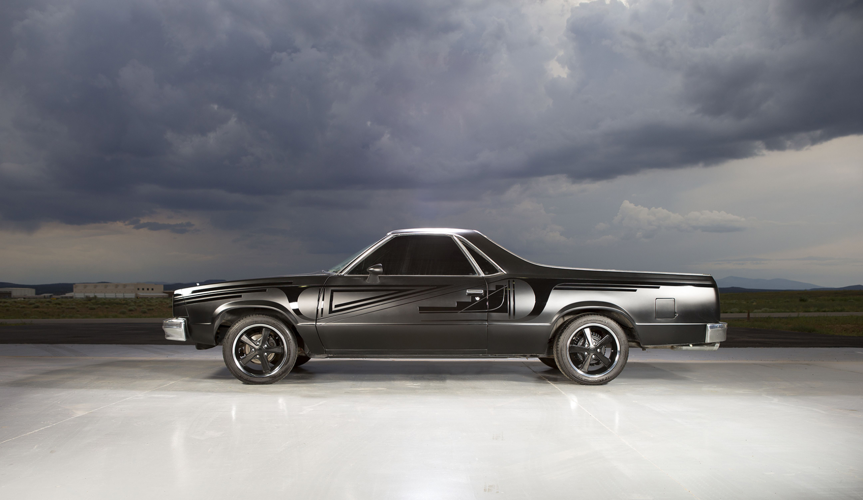
"Maria," Rose B. Simpson
The exhibition is full, rich and fertile, and includes 115 works that cross time and borders, informed by Native advisers and guided by elders. Whenever possible, title cards are presented first in Native languages, then in their English translations. Cultural requests are honored by notation in the exhibition’s signage — certain objects are considered sacred, for example, and the text asks that these works not be photographed. Though precolonial pieces are interspersed throughout the exhibit, they are introduced as contextual providers and historical examples of technique, never perpetuating the false and unspoken mythos that the cultures that created them are dead. Used here as markers of influence, they guide the viewer into the ways that creative practices have remained fluid, active and thoroughly engaged — not just with the past, but also with the present and future.
Across cultures, ornamented dresses are ways to visually demonstrate wealth, narrative and prowess: To have the excess to decorate showcases a level of wealth and success. Anita Fields’ contemporary coat “It’s in Our DNA, It’s Who We Are” is adorned with Osage words, including “woman” and “strength.” The embroidery of Osage orthography onto the coat is its own display of success: The investment into a unique alphabet is part of extensive efforts by the Osage Nation to reclaim and reactivate language through alphabet, app and action.
On the surface, the glossy sheen of stencil work on the matte metal of Rose B. Simpson’s restored 1985 Chevrolet El Camino “Maria” directly responds to forms of Tewa blackware pottery, but the conversation goes much deeper. Master ceramicist Maria Martinez was known for fostering a community of support and skillshare among her fellow craft ceramicists. By tying the aesthetic to Martinez, Simpson honors values of contemporary lowrider culture — a similar community with elements of craft, mentoring and restorative labor that empowers the people who participate within it. The Frist will host an artist talk with Simpson at 6:30 p.m. Nov. 14.
In Kelly Church’s “Sustaining Traditions: Digital Memories,” elaborate basketry is woven with bright bands of copper, and the visible techniques are historic transmissions of knowledge and narrative. In a modern nod, a flash drive containing techniques and instructions is housed inside. The green hues address the environmental losses caused by the ash borer beetle, whose colonies threaten to eradicate the ash trees that create the baskets. There’s obvious parallels to the colonization of indigenous lands, but in a form of resilient resistance, Church uses technology to embed hope, messages and instructions for a better future.
Whether in the bright Hopi weaving of Ramona Sakiestewa’s diptych “Nebula 22 & 23” or Amelia Winger-Bearskin’s digital pattern-making in “3D Beadwork,” ritual acts like these carry culture forward. In a history of change, these artists lead the way in embracing the fluidity of resilience, finding ways to remain engaged with past and future.



Post a comment as anonymous
Report
Watch this discussion.
(0) comments
Welcome to the discussion.
Log In
Welcome to the discussion.
Keep it clean. Please avoid obscene, vulgar, lewd, racist or otherwise abusive language. Comments featuring hate speech or threatening or violent content will not be tolerated.
PLEASE TURN OFF YOUR CAPS LOCK.
Be truthful. Don't knowingly lie or mislead.
Be proactive. Use the “report” link on any comment that violates our comment policy.
Share with us. We'd love to hear your feedback.