

There are giants of rock 'n' roll journalism — Lester Bangs, Robert Christgau, Robert Palmer — and then there's Greil Marcus. He isn't simply a music critic. He is, as Nick Hornby calls him, "peerless, not only as a rock writer but as a cultural historian." In Marcus' writing, music is often the point of departure. Where the vehicle goes from there is anyone's guess. But you can bet it will be an interesting, often thrilling, ride.
In 1975, Marcus delivered the landmark Mystery Train, a book that placed rock 'n' roll within the context of the great American archetypes, and would inspire countless cultural critics and rock journalists. He further solidified his status as a rock literary giant with Lipstick Traces: A Secret History of the Twentieth Century, Dead Elvis: A Chronicle of a Cultural Obsession and Invisible Republic: Bob Dylan's Basement Tapes. Marcus doesn't write biography. Instead, his writing often places art within a greater cultural context, whether that context is the notion of the American subconscious and the way Bob Dylan bootlegs comment on them, or the philosophical connections between The Sex Pistols and various separatist movements existing centuries before "Anarchy in the U.K." offended anyone.
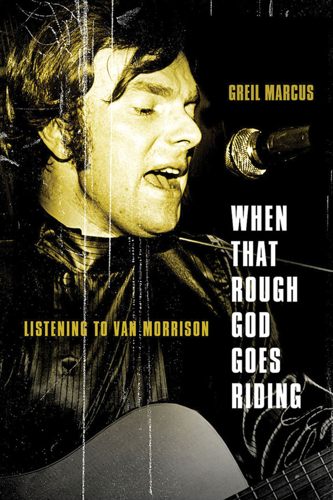
Marcus currently writes for Interview, The Believer and occasionally teaches graduate courses at The University of California at Berkeley. His latest book, When That Rough God Goes Riding: Listening to Van Morrison, considers the indefinable moments in an enigmatic performer's work where the artist transcends ordinary communication and reaches for the sublime. He took a break from his book tour to talk by phone.You've written, to great acclaim, about Elvis, Dylan, The Sex Pistols. In terms of pop-cultural iconography, Van Morrison seems an odd choice. Why him and why now?
Well, I wasn't interested in iconography, and it wasn't a choice of what's a subject that would fit with anything else that I had done. It really came about because I was interviewed for an NPR show about Astral Weeks. My wife heard it and said she liked what I'd said. She said, "That's who you should be writing a book about." That had never even occurred to me, and I realized maybe it was a good idea. This is someone I'd been listening to for so long, cared about, been thrilled by and disappointed by. And the notion of diving into all his work and trying to find those moments when he seemed to realize the musical quest he had been on all this time — that just struck me as something that I wanted to do and that I could just sit down and write.
You write about the concept of the "Yarragh" throughout the book. Can you explain a little bit about that and the way it pertains to Morrison's music?
The notion comes from something John McCormack, who was a traditional Irish tenor, said. He was talking about the difference between a good voice and an unforgettable voice: "You have to have the Yarragh!" I'm not completely sure what he meant by that — if he simply just meant that kind of sound, that kind of roughness. And certainly, just as a sound, you can hear that all through Van Morrison's singing, from when he was with Them in the mid '60s right till now. You know, he'll make a sound like that — something that doesn't need words, couldn't be translated back into words, but it's an expression of longing, of need, of frustration, of satisfaction.
Some of our readers are likely familiar with only Van Morrison's more well-known, radio-friendly work. What album would you recommend?
I guess two. One would be St. Dominic's Preview from 1972, which has so many different kinds of songs, so many different kinds of music on it. And yet, it is so passionate if you can deal with someone who is just going to be wearing his emotions like clothes. And it's also so smart, it's thought through. There's nothing casual about it. It's not pretentious, not over-serious, but it's just somebody doing his absolute best work. And that's a long time ago, 1972.
The other album I'd recommend is The Healing Game, which is from 1997, and it's very funny. But it's also full of drama, this great historical drama about Ireland and Belfast, a place sort of forgotten by history and forced into conflict that will never end. None of that's explicit; that's just a feeling that runs through it. And you know, it's not an album that got a lot of attention when it was released. I don't think it got terribly good reviews, and it's so rich.
I'm kind of surprised by that. I was almost sure you'd say Astral Weeks because it received so much attention in the book.
Right, well, people will find their way to Astral Weeks. I taught a class at Princeton four years ago. It was a seminar for undergraduates, so people were 19, 20, about that age. I asked everyone to fill out a questionnaire with their favorite books and movies and music so I could just get a sense of who they were or what kind of frame of reference I'd be working with. And out of those 15 students, four of them chose Astral Weeks as their favorite album. Now these are people who were born in the late '80s, 20 years after the album had been released. It's conceivable their parents weren't even born when the album was released. And yet this album had found them, or they found their way to it. So I don't think I need to recommend that.
Do you have any idea if Morrison has read your book?
No. You know, there're some errors in the book — a couple of major typos and two or three factual errors. I imagine if he read the book, he'd say, "God, this guy doesn't know what the hell he's talking about." But I haven't heard anything. I don't know that he's even aware of the book.
To read the full transcript of this interview and to see more local book coverage, visit chapter16.org, an online publication of Humanities Tennessee.



