

Emerald Fennell knows what you think of her, and daresay she even enjoys it. The English actress turned filmmaker behind divisive films Promising Young Woman and Saltburn returns to the silver screen this week with an adaptation of Emily Brontë’s enduring Gothic classic Wuthering Heights.
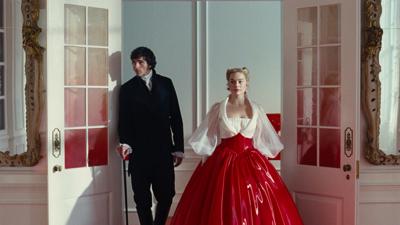
The trailers for the film tout Wuthering Heights as a classic Hollywood romance, complete with technicolor lighting, opulent costumes and a soundtrack by Charli XCX. (Cue flaming criticisms from keyboard warriors!) From the book's subtext of sex and desire moving to text, to period-inaccurate costuming, everything in the trailers that can be hated has been. The backlash has continued as the film’s premiere has grown closer, reaching a fever pitch this week as reviews began to drop. But fear not, internet skeptic: Emerald Fennell made this film with you in mind.
Wuthering Heights opens with a dark screen and a soundtrack of moans — what better way to kick off a Gothic classic than with a raunchy sex scene? Oh wait, that’s the sound of a man being hanged with a bag over his head. Oops! My mistake.
After the cold open, we move to the titular Wuthering Heights, where you can expect to see those garish sets from the trailer, right? Wrong. It’s dark, it’s muddy, and it’s striking but reasonably accurate for the setting.
Interspersed throughout the film are cutaways to squishy, oozing substances. Are those bodily fluids? Never mind, as the camera zooms out to reveal a snail on a window after the rain, or a questionable gelatin mold. Maybe it’s best to leave your expectations at home and approach Fennell’s vision with an open mind.
Literary purists will want to know that this version reduces the tale of Wuthering Heights to a single plot — that of the tumultuous relationship between Catherine Earnshaw (Margot Robbie) and Heathcliff (Jacob Elordi). Secondary characters and plots are cut, so don’t expect to see Mr. Lockwood, the ghost or the next-generation narrative presented here.
Fennell has (perhaps rightfully) caught some flak for the casting choices made here — particularly in selecting 35-year-old Robbie to play the canonically teenage Catherine, and Elordi as the racially ambiguous Heathcliff. As for the Heathcliff of it all, there’s no perfect answer. Brontë describes his dark features throughout the book, but without consistent characterization. Elordi captures the brooding spirit and occasional instability of the character well, but that’s not to say another choice wouldn’t have been more accurate — someone like Regé Jean-Page would’ve gotten my vote — but what’s cast is cast.
Don’t make the mistake of letting the noise around the casting detract from solid performances. Robbie and Elordi hold their own, but the real standouts are their child counterparts, Charlotte Mellington and Adolescence's Owen Cooper. Both actors cement their characters strongly, putting on compelling performances beyond their years while looking remarkably similar to their adult counterparts. (Shoutout to casting director Kharmel Cochrane!) Among the adult cast, Hong Chau (The Menu, The Whale) shines as the deceptively instrumental ward turned housemaid Nelly.
Like Fennell's previous films, Wuthering Heights features a strong visual language and a presentation that’s more about character than backdrop. The titular homestead is grounded in mid-19th-century reality — dark and weathered with echoes of its former grandeur. The moors themselves seem to breathe, and Edgar Linton’s new-money estate Thrushcross Grange is hyper-stylized with bright colors, modern art fixtures and unsettlingly perfect decor.
Within the grandeur lies the key to Fennell’s version of the story — a miniature dollhouse version of the manor. Catherine’s unhappiness centers on the fact that her life is not real. Her life at Thrushcross Grange — married to Linton, dressed in couture and ribbons — is as visually pristine as it is hollow. It starkly contrasts her life with Heathcliff at Wuthering Heights, messy and tumultuous but full of passion. As her former home decays, so does her relationship with Heathcliff. She chose life in the dollhouse, to be a part of the social elite. Despite her love for Heathcliff, he could never satisfy her vanity nor her desire to climb the social ladder.
Beneath the Old Hollywood veneer, Fennell’s Wuthering Heights carries the same core messages as the source text: It's a tale of love ruined by class prejudice, and of many lives ruined by the choices of the rich and powerful. It’s a sexy but studious rendition of a masterpiece best enjoyed by those who know their literature but aren’t afraid to let loose and let art be art. This is a movie, and not everything has to be serious.



