
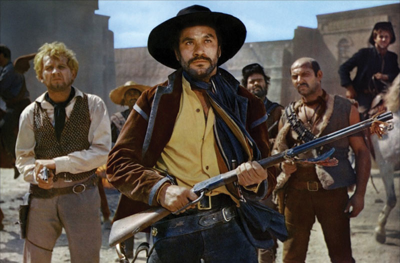

Back in the '70s, during his stints on The Tonight Show, Burt Reynolds spent a lot of time on Johnny Carson's couch recounting the bum assignments he'd taken as an up-and-comer. One of the worst, he said, was something called Navajo Joe. The spaghetti Westerns that made a star of Clint Eastwood, he explained, were directed by Sergio Leone — a genius, an artist, an auteur. No such luck for Reynolds. He got somebody named Sergio Corbucci.
The punchline brought down the house. But decades later, the late Corbucci may have the posthumous last laugh. On Christmas Day, one of the director's most ardent fans, Quentin Tarantino, releases Django Unchained, a down-South spaghetti Western variation that appropriates the title of Corbucci's biggest hit. Tarantino's hardly a Djohnny-come-lately on the subject of the Italian director: The Kill Bill saga borrows Ennio Morricone's Navajo Joe score for its climax, while Inglourious Basterds doffs a dagger to its forehead-carving revenge motif.
Through Dec. 13, however, you can go straight to the source, as The Belcourt offers a four-film introduction to Corbucci's savagely unsentimental West. Where the Hollywood Western traditionally concerned itself with the building and maintaining of civilization — the lawman facing down the gunslinger and his ilk in the street — the Italian-backed, Spanish-shot spaghetti Western cut the genre down to cold commerce. Deaths mean money, bodies mean money; killing is business, and business booms.
Even within that framework, the politically caustic Westerns of Corbucci — a former film critic who worked his way up the ranks of Italian cinema through sword-and-sandal programmers and the like — deliver a mule kick of unbridled cynicism. The zestfully vicious Navajo Joe (Dec. 5-6) opens by establishing scalps as currency; its villain is an upstanding town doctor who sells out his own kin to an outlaw gang for filthy lucre. "You can smell those dollars," the gang leader chortles, smacking his lips (which rarely match his dubbed dialogue).
Too bad they crossed Reynolds, an American Indian Terminator with a caveman coif and a skin tone that might be described as Burt Orange. At the end, Reynolds will reveal why he has racked up a double-digit body count — through a plot device maestro Leone reworked for his epic Once Upon a Time in the West — but not before dispatching the entire gang one by chopped, scattered and smothered one. It's a Western, all right (Reynolds' pony even comes by whistle), but its morally ambiguous hero's rejection of society and all it stands for — including its money — says we're a long way from John Ford's Monument Valley.
In 1966, Navajo Joe, co-scripted by poliziotteschi cult favorite Fernando Di Leo, was considered the most violent movie ever released by a major studio. With Morricone's banshee-cry theme doing its damnedest to scare every bird out of Spain, it anticipates the slasher movie at times in its stalk-and-kill single-mindedness, and torture porn in the hero's sadistic ordeal at the hands of captors, a ritual the spaghetti Westerns used to bear-prod the audience's bloodlust. (The mood must've been catching: The assistant director was future Cannibal Holocaust goremeister Ruggero Deodato.)
By comparison, Corbucci's acknowledged 1968 masterwork The Great Silence (Sunday, Dec. 2, one show only) is more like sci-fi in its otherworldly bleakness. Here a mute gunslinger (the great Jean-Louis Trintignant, a possible Best Actor contender this year for Michael Haneke's Amour) tracks a lupine bounty hunter (Klaus Kinski at his most feral) through a blizzard-struck Chernobyl of a Mormon village. Unstinting in its brutal nihilism — try re-hinging your jaw after that ending — it's as ferocious as Morricone's jewel-box score is elegiac and haunting.
Leone has gotten the lion's share of critical attention over the years, perhaps because his epic yarns have an operatic grandiloquence and an element of myth-making almost absent from Corbucci's termite Westerns. That will make it all the more interesting to compare their takes on similar material — such as Corbucci's 1968 The Mercenary (Dec. 8-9), which pits turn-of-the-century Mexican firebrand Tony Musante and Polish gun-for-hire Franco Nero against another of the director's vengeance-warped villains, American angel of doom Jack Palance. It arrived ahead of Leone's own Mexican Revolution reverie Duck, You Sucker! by three years; by that time, Corbucci had already made his own partial remake, Compañeros, reuniting Nero and Palance.
No self-professed spaghetti-Western aficionado will want to miss Corbucci's best-known film and a touchstone of the genre, 1966's Django (Dec. 12-13) — not just to bone up for Tarantino's movie, but to see how the director handles the Yojimbo/Red Harvest setup Leone spun into gold in the genre-defining A Fistful of Dollars. Corbucci immediately establishes the tone of grimy surrealism with black-hatted gunslinger hero Nero clanking robotically into view ... dragging a coffin. Meanwhile, a gang of banditos strips and flogs a maiden, only to have a rival ex-Confederate and his red-hooded Klansmen intervene — and claim the woman for their own.
Django's comic-book violence escalates to trick shots and outright machine-gunning, bookended by a nifty theme song that suggests being escorted through the Wild West by Andy Williams. (Go to our Country Life blog to hear it, though be warned it'll follow you like the jangle of spurs.) Taken as a whole, these movies form a burlesque of manifest destiny as a carnival shooting gallery that falls to the biggest, fastest, coldest gun. Burt Reynolds may have been right that Sergio Corbucci would always play second fiddle in the spaghetti Western's atrocity orchestra. For as long as the ammo holds out in Corbucci's merciless West, though, as the title of The Belcourt's retro suggests, it's Leone's turn to be "the other Sergio."
Email arts@nashvillescene.com.



