
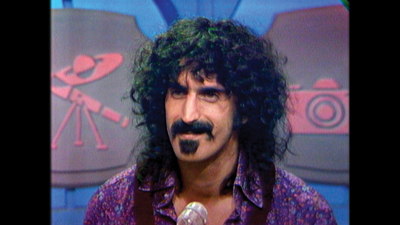


Frank Zappa was a colorful enough figure that it’s surprising German director Thorsten Schütte’s Eat That Question is the first major documentary about him. At first, the film’s cut-and-paste structure, assembled from clips that often can be found on YouTube, seems lazy, but the filmmaker proves to be a canny editor. Zappa said he hated interviews, but he seemed willing to talk to anyone who would listen to him — even a cop with a public-access cable show.
I must confess I’m not a huge fan of Zappa’s music. I think he peaked with his first few Mothers of Invention albums; afterward, his penchant for toilet humor and switching from 7/8 to 11/4 time signatures for no apparent reason took over. Nevertheless, I find him a fascinating character. And anyway, Eat That Question isn’t a Zappa concert film, although we do get to hear a fair amount of his music; instead, it concentrates on Zappa the pundit and activist. He was one of the few icons of the ’60s counterculture who didn’t take drugs. (He says he tried marijuana a few times and it just put him to sleep.) Known for his rock music, he became increasingly interested in classical composition toward the end of his life. His Bizarre/Straight Records label released great albums like Alice Cooper’s Easy Action, Captain Beefheart’s Trout Mask Replica and Tim Buckley’s Starsailor.
In the ’60s, Zappa challenged his audience of hippies. His third album, We’re Only in It for the Money, parodied The Beatles’ Sgt. Pepper’s Lonely Hearts Club Band with its artwork, and its lyrics pointed out the flaws of the counterculture, going so far as to opine, “Flower power sucks.” By the late ’70s and early ’80s, he was reinforcing the prejudices of classic rock fans faced with disco, punk and New Wave. Eat That Question shows a video of Zappa and his band performing a song mocking Devo. Never mind that Devo’s first few albums are better than the music Zappa was making around that period, or that Devo songs like “Through Being Cool” and “Beautiful World” carry on the spirit of astute social commentary heard on We’re Only in It for the Money.
But Zappa was always a complicated man, and Eat That Question addresses this as well. His 1979 song “Bobby Brown” seems like a string of rape jokes, homophobia and snickering references to anal sex and S&M. Viewed more sympathetically, it’s a critique of the hypocrisy of American masculinity. The biggest joke might have been on the late ’70s Scandinavian audience, which, according to Zappa, made the song into a hit because they didn’t understand the lyrics and thought it was a love song suited for slow dancing. Never mind that most Scandinavians speak better English than Americans — Zappa’s story about his surprise regarding this odd taste of commercial success is a better joke than the lyrics.
Eat That Question has been blessed by part of the Zappa family. Zappa isn’t around to answer questions, and the director had to work with what he found — that means repititious replies from Zappa about how he doesn’t take drugs. Apart from his music, Zappa may be best known for his activism against the Tipper Gore-led Parents Music Resource Center and their warning-label campaign. Zappa’s politics are at their most coherent and thoughtful here, and footage of the hearings is a hoot for anyone who’s forgotten the ’80s — Def Leppard’s Pyromania called before Congress as an ode to arson?
Eat That Question isn’t as moving as Asif Kapadia’s Amy, also assembled from found footage after the fact, but Zappa was far more in control over his life than Amy Winehouse. Sadly, he died before his time too — at 52, from prostate cancer. Even if I remain unconvinced of the greatness of most of his music, Eat That Question makes the best possible case for his merits in other areas.
Email arts@nashvillescene.com



