
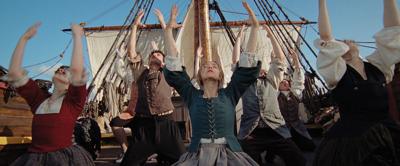

Mona Fastvold’s The Testament of Ann Lee is, without hesitation, one of the best films of 2025 — and it’s finally come to Nashville here in the front bit of ’26. It’s a biography, a legend, an illustration of the development of 18th-century Protestantism, and a searing example of what venues were available for a poor person of strong will to speak their very soul. The Testament of Ann Lee is also a musical, each of its numbers rooted in specific forms of experience and expression, each a kind of communion.
It has always struck me as strange that some Protestant sects are afraid of dancing and/or music — these arts are of the divine. Anyone who has ever attended one can attest that there is nothing more dreary than a Church of Christ funeral — and it feels doubly noticeable that you’re required to steep in this vacuum of any emotion other than quiet regret. You don’t have to be a religious person to find the Ann Lee story fascinating. But if you are, or if you have held onto the capacity to knock it around in your brain, there’s something overwhelming about what writer/director Fastvold and her cast are enacting; at times a ritualized meditation, at times a church tract brought to life, but also at times a shout of rage and a Suspiria.
We follow this young Mancunian woman (eventually played by Amanda Seyfried) through adversity and crisis, through the horrors of the world, into a spiritual flourishing. Spinning off from everyone’s favorite pacifists the Quakers, Ann Lee finds a transformative vision for her flock of Shakers, channeling the instincts of the body into dance and voice as a means of praise. Usually when religious fervor is depicted on screen, it’s either in a collective manner where large numbers amplify what we’re meant to be feeling and what’s being shown, or it’s a mania — sometimes it’s transcendent, sometimes it’s psychosis. But this is all about taking the carnal (embodied by Christopher Abbott at his most reptilian-brained and single-minded) and shunting it into kinesis. We experience the ecstasy of the Shakers through dance, and it’s a choice that makes perfect sense for cinema — the spiritual is made physical in an expressive and adaptive mode passed through each of the congregants. This isn’t empty, cold hierarchy radiating out from hundreds of eyes — this is something personal, and more importantly, something that can’t be faked just by tithing checks and ignoring tenets.
The life of Ann Lee is a reaction to horror and injustice and circumstance; a life that thankfully could find a new path rather than being bound to the grinding mechanism of medieval tradition. It’s inspiring in a big-picture way, but also incredibly sobering when you stop to think about all the incredible thinkers and voices who were never able to escape the circumstances of being caught up in power structures they never had a chance of toppling and reworking.
It’s a complex emotional experience when the Annapurna Pictures logo comes up at the beginning, because it’s been too long since we’ve seen it, but also because it’s representative of the one member of the Ellison family (Megan Ellison) not committed to fascist oligarchy. But if that signifies something to you (as a cinephile), it taps a very fallow point in the subconscious, allowing a lot to dig in and grow. There’s a moment when Lee and her ragtag congregation, upon arriving in America, are horrified by a slave auction, literally shouting shame at what is happening and the institution itself, and it is a staggering indictment of Right Now, because this feels gutsy. How far we’ve fallen — calling out the evils of slavery feels like such an uncharacteristically courageous declaration at this specific moment.

Brady Corbet’s Golden Globe-winning film opens this week at the Belcourt (in 35 mm) and Regal and AMC locations
Everybody likes to talk about how religious freedom is one of the tenets that the very idea of America is built on. It’s what drew the Shakers (along with many new sects that came up in the mid-18th century during the rise of Methodism) here, but it’s never quite that simple. It’s no surprise that the idea of “religious freedom” has been weaponized against anything and everything that runs against the orthodoxy of whoever is in power, but it is staggering that it’s been that way since the very beginning. This is quite the fascinating companion piece to The Brutalist (Fastvold’s last collaboration with her romantic partner and co-writer Brady Corbet), as both are about the way America “welcomes” foreign visionaries and proceeds to take their distinctiveness for its own enrichment.
Amanda Seyfried can do just about anything. She was in Mean Girls and Twin Peaks: The Return. I mean, she was on All My Children, and she starred in an Atom Egoyan psychodrama. As a performer, she is not typically bound by genre or content, and she gives 100 percent every time. In 2025 she gave us this transcendent, spiritual earthquake of a performance as well as the glorious operatic trash The Housemaid, and she’s presiding in both films. She digs deep into the historical texts of Ann Lee as well as the legends and ephemera, allowing this film to sort of be its own primary text and apocrypha at the same time.
There’s stuff in here that will infuriate a lot of people. I can see some folks calling it blasphemous — it’s really just a question of how strong your faith is and whether you’re willing to do the emotional work. When you compare it to something grotesque like the Quiverfull movement, Shakerism and its proscription of sexual activity make sense (there’s some overlap with the dualist view of the 12th-century Good Christians here, tangling with the asceticism that had been percolating in Christian thinkspaces since the Byzantine Empire) — rather than bringing more and more lives into the world to suffer and die in separation from the divine, instead make a point to care for all those who are already here and could use the love and resources.
Fastvold and her cast aren’t about making thought points — they’ve got a story to tell, a captivating one. But anyone who’s been horrified by what is continually done in the name of religion is going to find a lot here to grab hold of. There are times when a film is truly breathtaking, not in terms of overwhelming the viewer with spectacle or dopamine, but when something happens that overwhelms who you are and leaves you dazed on a cosmic scale, in a transformative state. And this film deserves all of the attention that, in a more hopeful world, it would rightly receive.



