
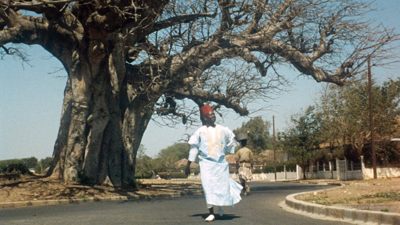


In his second full-length feature, the 1968 dramedy Mandabi, Senegalese filmmaker Ousmane Sembène presents a land that’s filled with both beggars and choosers. That’s what chief protagonist/unemployed family man Ibrahima Dieng (Makhouredia Gueye) discovers when he receives a money order for 25,000 francs from his nephew (Mouss Diouf), who’s trying to make a life for himself over in Paris.
Since Dieng lives in a run-down part of Senegalese capital Dakar, word travels fast about his newly acquired wealth. People come out of the woodwork looking for a piece of the loot, from family members to neighbors to, of course, hustlers and con men. (As it happens, some of those con men are also his family members and neighbors.)
Mandabi is being rereleased this week in a crisp-ass 4K restoration via the Belcourt’s virtual cinema ahead of The Criterion Collection dropping the Blu-ray next month. Adapted from Sembène’s own 1966 novella The Money-Order, Mandabi is both a comedy and tragedy, and it’s the director’s first film in his native Wolof language. He finds a willing, oafish lead in Gueye, who plays Dieng as a slothful, self-centered sumbitch who’s too stubborn and slow on the uptake to realize when he’s getting played. In an obvious fuck-you to Senegal’s problematic — and patriarchal — social norms, Sembène also gives him two wives (Ynousse N’Diaye and Isseu Niang) who, despite waiting on him hand and foot, are savvier and have more sense than this so-called king of the castle.
Despite Mandabi’s sunny scenery, Sembène continuously lets us know that darkness is always afoot for this fella. This is especially the case when he gets out in the city and comes across swindlers, be they small-time grifters or bureaucratic schemers — the guys he encounters when he tries to get the identification needed to cash the damn thing. While Sembène presents a side of Africa (West Africa, specifically) many in the Western world were most likely not hip to at the time, the themes established here are undoubtedly universal. I mean, who among us hasn’t been flanked by folks in the neighborhood every time we get a few dollars in our pockets? Who hasn’t been betrayed by people we thought were loved ones the minute money enters the picture? Who hasn’t thought that the scavengers and scoundrels seem to get away with murder while decent, down-on-their-luck folk constantly get shafted? Who hasn’t felt like — to paraphrase Cyndi Lauper — money changes everything, but not for the better?
Near the film’s end, Sembène gets a supporting character to dispense some advice to the figuratively and literally poor schnook (as well as the audience) as cynicism starts to sink in. Even though Sembène was obviously reaching out to his African brothas and sistas with this coda, considering the hell we’ve all been through these past four years, I’m sure American viewers who are desperate for a hopeful future will also take Mandabi’s final words of wisdom to heart.



Post a comment as anonymous
Report
Watch this discussion.
(0) comments
Welcome to the discussion.
Log In
Welcome to the discussion.
Keep it clean. Please avoid obscene, vulgar, lewd, racist or otherwise abusive language. Comments featuring hate speech or threatening or violent content will not be tolerated.
PLEASE TURN OFF YOUR CAPS LOCK.
Be truthful. Don't knowingly lie or mislead.
Be proactive. Use the “report” link on any comment that violates our comment policy.
Share with us. We'd love to hear your feedback.