
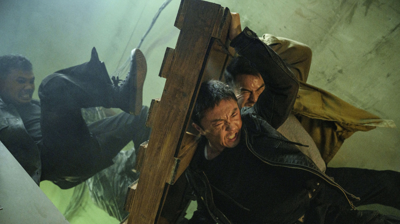

Everyone loves a good fight scene, but it often feels like the “arts” part of “martial arts” is left out of the equation. While movie magic can make almost anyone look great, there is something about true combat prowess that you just can’t fake. Only those who are willing and able to endure the physical toll the action genre demands can leave a legacy in hand-to-hand combat — from the dedication to mind and body of Bruce Lee to the perfectionist takes of Jackie Chan and Keanu Reeves’ grueling training in the John Wick franchise.
So what happens when you gather a whole cast and crew of people who know what they are doing and love the art of the fight? The Furious, opening this week, did just that, bringing together Jet Li’s son (Xie Miao) in the lead role, The Raid’s Joe Taslim and Yayan Ruhian in supporting parts, and Everything Everywhere All at Once choreographer Brian Le as a true wild card, with Crouching Tiger, Hidden Dragon producer Bill Kong behind the scenes and Donnie Yen’s longtime choreographer Kenji Tanigaki directing. The product is one of the greatest collections of talent across pan-Asian action films.
When Wang Wei’s (Miao) daughter is kidnapped and the corrupt police force won’t help, he takes matters into his own hands with the help of journalist Navin (Taslim). Together they take on an entire criminal underground with their fists, feet and anything lying around that can be used as a weapon.
The working philosophy of the movie is simple: “Is this badass?” Everything else is in the film to serve these badass moments. The plot is simple, the acting is messy, and events happen not to force the plot, but to give us more fighting. Sometimes things aggressively don’t make sense, but damn if they aren’t badass.
The filmmakers know why you are watching, and that’s to see people hit each other — and The Furious delivers that by the truckload. The film opens with a fight scene, and probably doesn’t go more than five or 10 minutes without an action sequence. Each major character has their own unique fighting style, and the cast has mastered every strike at a rhythm and speed that allows the camera to remain still and focused on the talent displayed. There is no reliance on shaky cam effects and edits to sell the fight. Each battle builds toward the next, culminating in a final fight that will have cinema audiences cheering like they’re in sports stadiums.
The Furious is the perfect example of a film that is stripped down and focused solely on the art of the genre — taking pieces of what made action movies from Hong Kong, Indonesia and Thailand memorable — with just the right amount of narrative justification (beating up child traffickers, which means you’ll feel no guilt as you watch countless bodies pile up). It carries on the traditions of several regions, and is a cohesive work of international cooperation — it embodies the same spirit as Jackie Chan’s Police Story and Timo Tjahjanto’s The Night Comes for Us. These characters are all original, but they carry the weight and legacy of generations of martial arts and high-octane genres. The Furious feels like a huge crossover event, built on legacy rather than recycled intellectual property.
The Furious does indeed kick ass — and feels like the cinematic equivalent of a bump of cocaine. It wasn’t assembled in a board room with designs on making something marketable. It’s a passion project made using elite ball knowledge, and it gives the people what they want.



