
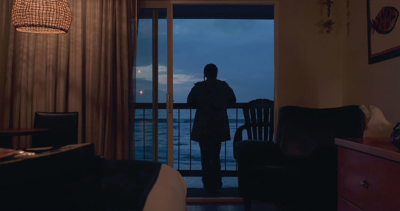


It’s easy and perhaps clichéd to compare the frames of a film to a landscape painting. But for all the stunning vistas that have been captured in more than a century of cinema, few films truly exude the authentic feeling of the natural world. Filmmaker Sky Hopinka, mostly known for short avant-garde work but now making his feature-length debut with Maɬni — Towards the Ocean, Towards the Shore, is uniquely concerned with landscapes, and captures them with a rare intensity and fullness. To view his work is to soak in a warm pool of vibrating sounds, steaming vapor and lush foliage.
Just as essential to Hopinka’s films as landscapes are the people who fill those landscapes, specifically the Native American and indigenous populations of this continent who have been so often misrepresented, stereotyped and colonized by mainstream cinema. Hopinka is of Pechanga heritage and a member of the Ho-Chunk nation, and an active speaker and teacher of the Chinuk Wawa language native to the Columbia River Basin of the Pacific Northwest. As cinematic language has so often been used as a weapon against indigenous people, Hopinka aims to quite literally create new languages — both in his use of a poetic, mixed-medium form and his seamless blending of Chinuk Wawa and English.
Hopinka spends intimate time with two Native Americans born in the Pacific Northwest, both friends of his but unrelated, though each is at a similarly crucial juncture in life. Jordan Mercier is an expectant father wondering how to pass traditions on to the next generation, his hair braided long in honor of his ancestors underneath a Portland Blazers cap. Sweetwater Sahme is an expectant mother who regularly goes to a waterfall to cleanse herself and the child in her womb, but also to meditate on what motherhood will mean for her, looking into a reflecting pool both literally and figuratively. Whenever Jordan speaks in Chinuk Wawa, the subtitles are presented in English; whenever Sweetwater speaks in English, the subtitles seamlessly flip to Chinuk Wawa, bringing two traditions and cultures together formally, just as its subjects bring together a storied culture that needs to be preserved amid the struggles of contemporary life.
Just as he weaves language together, Hopinka shifts between extended personal conversations and more abstracted, sensorially stimulating sojourns into the physical landscape that so crucially shaped the cultural practices and personal beliefs of its original inhabitants. Hopinka captures tradition and ritual at every level, from public performances of passed-down song and dance in public halls and on high school football fields, to the most personal and private ways of carrying your ancestors with you — like Jordan’s hair and Sweetwater’s waterfall cleanses. The film’s color palette is sometimes bold and saturated, pulsating in your eye as an entire ecosystem of environmental sound envelops you.
Though Maɬni (pronounced “moth-nee”) overflows with visual beauty and displays a positive embrace of one’s heritage and history, it also reckons with tradition on more complicated terms. Its subjects navigate how to pass down the uplifting parts of their heritage while freeing their children from cycles of trauma, addiction and mental illness — issues so terribly prevalent in often underserved reservations and other Native American communities. As its title suggests, Maɬni — Towards the Ocean, Towards the Shore is at the point where the water meets the sand, on the uniting line of boundaries: Chinuk Wawa and English, avant-garde and documentary, past and present, nature and humankind.



