
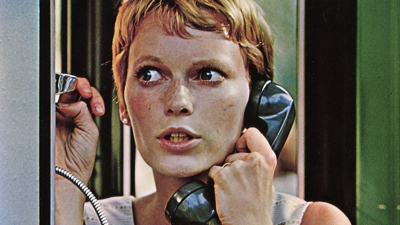


Mia Farrow in a still from Rosemary's Baby
The Nashville Film Festival wraps up tomorrow, and it’s been a staggering nine days of film. Nearly each one I saw topped the one before it. As usual, the festival staff and volunteers have been enthusiastic companions throughout the week. Volunteers wore identical festival T-shirts made specially for this year. The purple shirts bore the unmistakable likeness of Mia Farrow, her pixie haircut synonymous with Roman Polanski’s 1968 film Rosemary’s Baby.
Rosemary turns 50 this year, and the festival honored the classic horror film on Wednesday evening with a screening. Much of the fest’s promotional material, including the festival’s program and the front page of its website, features a shot of Farrow looking cornered, eyes wild with fear.
Director Roman Polanski, of course, was not present, because Roman Polanski hasn’t set foot in the United States since 1978. That's when he fled the country after being convicted of the statutory rape of a 13-year-old girl named Samantha Gailey (now Geimer) the year before. In her testimony, Geimer said Polanski gave her champagne and Quaaludes and raped her orally, vaginally and anally while she begged him to take her home. Polanski’s attorneys plea-bargained down to statutory rape, but he fled before his sentencing. Polanski is a dual citizen of France and Poland. Both countries have refused to extradite him.
According to Nashville Film Festival artistic director Brian Owens, the festival decided in June 2017 to use the imagery from Rosemary’s Baby. The festival's graphic designer flipped through movies released in 1968 and was drawn to the startling imagery of the film. “Of course, it initially didn’t cross anyone’s mind –– the Polanski issue,” says Owens. “It’s just a cool image. It makes sense. And then in looking for the rights to be able to use the image, it made it much more cost-effective to be able to screen the film because it opens up rights in a different way. … Once the #MeToo movement really broke, that’s sort of when it all got into our heads, ‘Oh no. This is going to create some awkwardness.’ That’s when we made the decision, let’s use it as an opportunity to have a conversation instead of just throwing things out.”
Owens works with a small programming team of three full-time staff members: Josh Escue, Emily Gaines and Robin Robinson.
Polanski’s crime against Geimer was of course common knowledge prior to the #MeToo movement, which gained mainstream recognition in October 2017 with a New York Times exposé that described three decades of sexual misconduct, abuse and harassment allegations against Hollywood producer Harvey Weinstein. The floodgates opened.
But prior to that, in 2010, actress Charlotte Lewis alleged that Polanski sexually abused her on the set of his film Pirates in the early 1980s when she was 16 years old. Also, in August of last year, a woman identified only as Robin came forward alleging that Polanski sexually assaulted her in 1973, when she was 16. A fourth came forward in October at the height of the #MeToo moment. Renate Langer alleged that Polanski raped her in Switzerland in 1972, when she was 15.
Polanski again made headlines this month when the Academy of Motion Picture Arts and Sciences expelled him, along with Bill Cosby (convicted last month of sexual assault), from its membership. In 2003, Polanski won the Best Director Oscar for The Pianist. The film also won Cannes Film Festival’s highest honor, the Palme d’Or.
In response to his expulsion, Polanski called the #MeToo movement “collective hysteria of the kind that sometimes happens in the society.” He compared the industry’s response to when North Koreans mourned the death of dictator Kim Jong-Il and said, “You can’t help laughing.”
Owens agrees that the issue reveals inequity across the industry. “We knew very much that we needed to address how the industry treats women and how the industry treats men who have done aberrant things,” he says. At Wednesday night’s screening of Rosemary’s Baby, Nancy Roche, a professor at Watkins College of Art, Design and Film, raised the issue in her introduction to the film.
Says Owens: “This is what the discussion was last night, and I’ll tell you my personal feeling with Polanski’s films. I’m not going to throw away the works that happened before. I am not comfortable with his current work. I’m happy that the Academy pulled his credentials, and I wouldn’t fund his current work. But I don’t want to blame Chinatown or Rosemary’s Baby or Knife in the Water. I think that they’re canonical films, and we can’t lose them.”
The festival held a panel discussion today at 2:30 p.m. featuring Roche, Naia Cucukov of Walden Media and Hazel Joyner-Smith of the International Black Film Festival of Nashville. The panel is called "It’s Time: A Talk About Diversity and Inclusion."
In the festival’s promotional material, NaFF didn’t recognize Rosemary’s Baby as an opportunity to address #MeToo. “There I would go back,” says Owens. “I would say contextually, that’s the part that we missed. We should have made that more public. … With our small staff, we thought, ‘People will get it,’ but obviously it doesn’t always translate.”
Owens says he is proud that more than 40 percent of the films shown at the festival this year are created by women. “I want that number to keep going up,” he says. “I think it’s going to, because especially in the independent world, women have more access to tell their stories, and that makes it, from a programming perspective, that much easier.”
This week at Cannes, several women contacted France’s minister for gender equality through a special helpline to report sexual harassment at the festival. Put that beside this statistic: Over the past 71 years, 82 films directed by women have been nominated for the Palme d’Or; men have directed 1,645 of the nominated films.
“I think that’s also how we address the issues that are part of #TimesUp and #MeToo, is having more women telling their stories," says Owens. "And similarly, having more people of color telling their stories, having more LGBT people telling their stories. I think it’s paramount that we keep talking. If we can use a piece of art that’s at least largely renowned, if controversial, to keep the conversation going, I think it’s imperative to us that we do it.”
Still, it is disconcerting that the festival’s programming team didn’t consider Polanski’s history until #MeToo was popularized, at a point when pulling out of screening Rosemary’s Baby was not a financially viable option for the festival. Over the past 40 years, a host of actors and industry figures have chosen to work with Polanski. Critics have continued to heap accolades upon him, universities have continued to study him, and film festivals have continued to honor him.
It’s a blurry field that raises many questions. Should we condemn a convicted rapist before a movement against his ilk? Should we have public discussions about sexual abuse before outside pressure makes it impossible not to? Should we work a little harder to showcase filmmakers that do not have long, terrible, troubling histories?
The film industry must hold abusers accountable whether it is in fashion or not. And film festivals have the same social and moral responsibility. Viewers can still love Rosemary, Chinatown and Knife in the Water. That’s for them to wrestle with.
But if we stop giving the stage to abusers, we might uncover more classics.



