
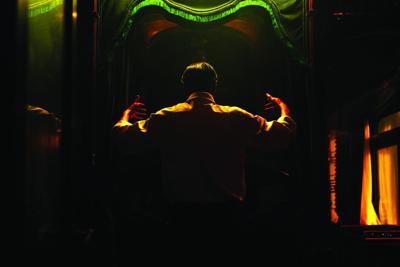

In one of his 2025 New York Film Festival dispatches, Scene senior film critic Jason Shawhan summed up Bi Gan’s Resurrection this way: “If Christopher Nolan, Guy Maddin and Wong Kar-wai got in an absinthe fight with detectives and robots in a wax cathedral.” Trust me when I say those auteurs aren’t the only ones the Chinese filmmaker aesthetically samples for this damn-near-three-hour art ride.
I get the feeling the Long Day’s Journey Into Night director saw Leos Carax’s acclaimed meta-movie Holy Motors and went into hold-my-Tsingtao mode. Just like when Carax put French actor Denis Lavant in a limo and sent him on a genre-bouncing journey assuming various roles (lead that accordion march!), Bi puts his leading man — in this case, actor/pop star Jackson Yee — through a surreal but captivating wringer.
Set in a future in which humanity has literally let go of their dreams in favor of longevity, Resurrection features Yee as a “deliriant” who can still come up with some visually mind-blowing fantasies. A hunter (Taiwanese director Hou Hsiao-hsien’s frequent collaborator Shu Qi) known as an “other one” tracks him down Inception-style and gives him a slow but peaceful death by installing a film projector inside him and having him jump from one highly cinematic, production-designed-to-hell dream sequence after another.
We follow our dreamer through six segments — representing the six senses (sight, hearing, smell, taste, touch and mind) recognized in Buddhist thought — and each one is a cinematic stew of influences and inspirations. The opening is a mashup of Guy Maddin, Buster Keaton and the Chinese silent films of the ’20s and ’30s. We then leap to the film’s most sci-fi sequence, a Blade Runner/Alphaville/Dark City pileup in which you can also spot Barry Lyndon’s natural, candlelit cinematography in one scene, along with the suspenseful, mirror-filled climax from The Lady From Shanghai (and Enter the Dragon).
Although he gives props to Western films and auteurs, Bi (who also co-wrote the script) also shows love to his fellow Asian visionaries. One segment — in which Yee is an art thief stranded at a snowy Buddhist temple who summons a chain-smoking spirit — looks like a Cast Away/Never Cry Wolf hybrid helmed by that Hong Kong wackadoo Stephen Chow. Another segment, with Yee as a con man who takes an orphan girl under his wing, is basically Paper Moon if a Taiwanese New Wave director like Hou or Edward Yang got their hands on it. If you know Bi’s work, you know he has to end this thing with a crazy, one-take sequence. This time around, it’s a lurid-but-sprawling vampire love story that plays like Breathless if it were done by Nicolas Winding Refn.
This film is Bi’s salute to his fellow cinematic dream-weavers, done as ambitiously and audaciously as possible — a big-screen bouillabaisse that’ll certainly make cinephiles giddy. (Novices who just like watching intriguing films will get a kick out of it too.) Like most of today’s auteurs, Bi is a proud devotee to the Church of Cinema. A good movie can give a viewer ideas, dreams, even hope. By presenting a dystopian future where creativity has been zapped from people, and those who can still dream are seen as inhuman outcasts, Bi gives us a beautiful, dark, twisted fantasy in which imagination — or anything that motivates it, like cinema — is a dangerous thing to have.
Resurrection is the recent winner of the Music City Film Critics’ Association’s Jim Ridley Award, created in honor of the Scene’s late, great editor-in-chief and film critic — and Ridley would’ve loved this movie. Since we’re living in a time when movies are becoming seen as streaming content for doomscrolling homebodies rather than works of visual art best experienced on a silver-screen canvas, Resurrection is another eerily prescient, dystopian vision. It’s also a wondrous reminder to go see some gotdamn movies before President Orange Fanta and his administration outlaw those too!



