
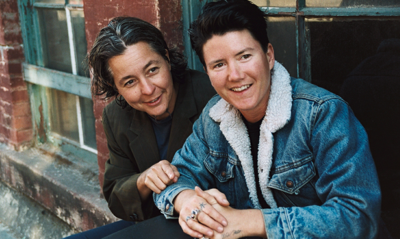
The first time I saw By Hook or by Crook, I was looking for a good hang, but I was really looking for myself.
It was 2004, and my first girlfriend introduced it to me as I was coming out as a butch dyke. The film had not yet become the queer-cinema canon it is today. Back then — before algorithms made longing searchable — queer culture often traveled hand to hand, room to room, lover to lover, friend to friend. Someone placed an object in your path and said, “Here, this might help.”
More than 20 years later, I watched it again — this time as a historian of cinema, as a Nashvillian and as a transgender man looking back across the bridge between my life as a baby butch and the manhood I embody now. By Hook or by Crook lives under that bridge, watching over the crossing.
The 2001 film — written and directed by Silas Howard and Harry Dodge, who also star, and produced by Steak House — returns to the Belcourt on July 15 in a 25th anniversary 4K restoration as part of the theater’s annual Queer Qlassics series. It is considered trans-butch canon and one of the first successful queer indie films shot on MiniDV. True enough. But accuracy can flatten unruly things. The film is also an on-the-road buddy story, a love letter to a disappearing San Francisco, a record of queer friendship and a rare cinematic portrait of people whose genders did not ask permission.
Howard plays Shy, a grieving small-town dreamer who comes to the city after his father’s death and slips into petty crime. Dodge plays Valentine, a funny, openhearted adoptee searching for her birth mother. Together they move through bars, streets, hustles and private wounds. They are broke, strange, working-class, tender and difficult to categorize. The film does not explain them. It lets them be.
In the film’s press materials, Howard describes the film’s origin plainly: “We didn’t see people who looked like us — gender-nonconforming and trans folks — in mainstream media, and we knew waiting around to get permission to be seen was futile. So we just said, ‘Fuck it. Let’s tell our own story.’”
That sentence still feels like important advice.
When I spoke with Howard and Dodge, I wanted to ask about community, gender, masculinity, queer imagery and queer eldership. I also wanted to ask something that came less from journalism than from the body. Rewatching the film as someone navigating transition, estrangement and heartbreak, I was struck by how deeply it understood transmasculine tenderness.

Talking to Belcourt historian and archivist Teddy Minton about celebrating the Nashville institution’s rich history
Shy and Valentine mirror each other without becoming the same person. Both carry abandonment wounds, but they respond to intimacy differently. Shy runs from connection. Valentine runs toward it with devastating openness. Shy says, “Caring about people is embarrassing — love is embarrassing.” Valentine tells him, “Don’t worry about your heart breaking — if it breaks open, you can feel everything.” Billie (a character played by Stanya Kahn), already clear about what pain costs, tells Shy, “It’s not a good idea to fall in love with the brokenhearted.”
Those lines make the film feel less like a crime story than an allegory about survival strategies hardened around pain. Shy’s toughness is not confidence. It is embarrassment at being alive enough to need someone. Valentine’s openness is not innocence. It is reckless bravery.
Howard resisted turning that dynamic into a thesis. “It was more personal,” he said. Shy drew from fictionalized parts of his life, especially “the outsiderness and the fear of connection.” By Hook or by Crook never treats transmasculinity as a lesson plan in manhood. It does not ask Shy to represent everyone who ever lived somewhere between butch, trans, dyke, man, outlaw, son or ghost. Instead, it begins with one person’s ache and trusts the politics of identity to surface through the wound.
Dodge said something similar about butchness. “These people were just people, and it was going to be a movie about love. It was going to be a movie about friendship, and they were going to be as weird as they needed to be.” Weird as accuracy, not spectacle. Weird as the truth about love: messy, imperfect and confusing, except when it suddenly is not.
The deeper our conversation moved into gender, the more the film resisted the categories later used to celebrate it. Dodge talked about finding the word “butch” slowly, and needing it to expand once he claimed it. The available models felt too narrow: too suave, too controlled, too invested in a coolness he did not recognize in himself.
He described identifying with Pee-wee Herman and Bette Midler. “Somehow I learned to be a butch from Bette Midler,” he said.
That sentence reveals more than theory could. Queer people rarely became ourselves through official channels. We learned gender sideways — from television, punk shows, thrift stores, bar culture, performance art, celebrity gestures, crushes, jokes, humiliations and private acts of imitation. We misread things productively. We took what was not meant for us and made it useful.
Dodge also pushed against treating masculinity as something men owned and everyone else borrowed. Even “female masculinity,” associated with Jack Halberstam’s work, had frustrated him because it seemed to route butch experience back through men. Why did butch masculinity have to be imitation? Why could it not be something women, butches, dykes, bulldaggers and gender-nonconforming people built themselves?
The question still cuts. Dominant culture, and its minions in the manosphere, still imagine masculinity as property. “Real” cis men hold the deed. Everyone else trespasses. By Hook or by Crook rejects that arrangement. It treats masculinity as a shared language, full of jokes, poses, tenderness, erotic charge and protective camouflage.
The film’s emotional truth depended on the world that made it. Howard and Dodge met in 1989 while working at Cafe Commons, a San Francisco lesbian hangout, during a period shaped by AIDS activism, queer punk, performance art and direct action. By the early 1990s, Howard played guitar in Tribe 8, while Dodge became a figure in spoken-word and performance art. In 1993, they helped start Red Dora’s Bearded Lady Cafe & Truckstop, an inclusive cafe and performance space. Steak House moved through a related club and performance world before bringing producing instincts to the film.
That history explains why By Hook or by Crook does not feel like actors performing a queer and trans social world. It feels inhabited by people who came from one.
Howard said they cast themselves first, then cast friends. Dodge remembered the bar scene as “movie magic.” They shot the exterior of the Lexington Club, a queer women’s bar, then used the interior of the Hole in the Wall, a gay bar with Polaroids, a decade-old candle drip, a Harley hanging from the ceiling and naked men in white tube socks in the back. They waited until the bar closed, then filled it with friends at dawn.
That scene now works as a document of queer place-making. It captures spaces where people practiced becoming possible to themselves.
Howard called the film a love letter to San Francisco. Dodge complicated the sentiment. The tech boom had begun. People were being pushed out. The film looked backward even as the world it loved was still present. It preserves San Francisco not as scenery, but as a contested social body where freedom existed before money renamed it amenity.
The contradiction is sharp. The same tech money displacing queer communities also helped finance the film. Friends who once made little suddenly had dot-com salaries and gave some of that money to the production. Gentrification helped finance the record of what it would later help destroy.
Nashville understands that contradiction more each year. Cities often consume the people who make them interesting: queer people, artists, musicians, service workers, bartenders, punks and underpaid geniuses who make a place feel alive. Then capital discovers that aliveness, packages it, raises the rent and wonders why the room went quiet.
Nashville’s Lipstick Lounge opened in 2002, the same year By Hook or by Crook last played here at the Nashville Independent Film Festival. When I mentioned Nashville still had one of the country’s remaining dyke bars, Dodge answered simply, “Wow.” His small response carried the weight of vanished places — and the irony that Nashville retains what is often associated with coastal queer life.
The film’s making has the texture of survival. In 1998, Howard’s partner and future wife Sarah Bartholomew gave Howard and Dodge $600 so they could take a week off work and lock themselves in Howard’s studio. By the end of that week, they had a script. Their last meal was hot dog buns without hot dogs and beans from a can.
They raised money before crowdfunding made community appeals look professional. They kept $10,000 in a shoebox under the bed until Steak convinced them to form an LLC and sell shares. Howard and Dodge started a large-item trash-removal business to support the film. Dodge delayed the shoot after being cast in John Waters’ Cecil B. Demented, gaining on-set experience from one of Steak’s film heroes. They shot on MiniDV because they had to. That necessity became form.

East Nashville’s The Lipstick Lounge is one of few remaining lesbian bars in the U.S.
The restoration carries its own metaphor. In 2021, queer film historian and consulting producer Jenni Olson encouraged Howard, Dodge and Steak to restore the film and apply for a Sundance restoration grant. Sundance support helped begin the process, and UCLA Film & Television Archive became involved, along with Sundance Institute, the Academy Museum, Outfest, Frameline, Steakhaus Productions and others.
The work itself was stubborn and material. During original post-production, the filmmakers used a filter effect plug-in called “The Magic Bullet” to give MiniDV footage a cinematic look. To restore the film properly, they had to return to the original Final Cut timeline and output a clean version without that effect. That version lived on 20-year-old hard drives. Miraculously, they worked.
Assistant editor Yousef Gouda spent months decoding and restoring the original edit. Post-production consultant Ross Lipman spent additional months conforming the footage for modern post-production. With guidance from Lipman, the Academy Museum and Illuminate, the team up-rezzed, retitled and color-corrected the film into a new 4K master. The process took about four years. The restored film premiered in 2024 at the Academy Museum. Now, in 2026, Altered Innocence has released it theatrically.
When I asked Howard and Dodge about queer eldership, the question felt both sincere and impossible. What does it mean to become an elder when so many people have been denied the chance to age? What does it mean for young artists to become old enough to revisit their work and speak across generations?
The answer was in the film’s refusal to become respectable. By Hook or by Crook has aged, but it has not softened into nostalgia. It remains funny, dirty, tender and politically alive. For younger queer and trans audiences, it proves gender complexity did not begin yesterday. For older viewers, it preserves worlds made under pressure and partly lost to money, illness, violence, migration and time.
The film left me thinking that aging as a queer person is not only private good fortune. It is public evidence. Every surviving body carries a history of rooms entered, names carried, categories refused, friends buried, cities changed and tenderness protected by performed grit.
By Hook or by Crook gives that evidence back to us. It still refuses to explain itself. It still believes friendship can be the technology of survival. It still knows love is embarrassing and necessary. It still asks whether we have built enough rooms for the people coming next.
In a city and state still deciding who and what deserves to be here, that does not feel like nostalgia. It feels like a warning, and maybe a blessing.



Post a comment as anonymous
Report
Watch this discussion.
(0) comments
Welcome to the discussion.
Log In
Welcome to the discussion.
Keep it clean. Please avoid obscene, vulgar, lewd, racist or otherwise abusive language. Comments featuring hate speech or threatening or violent content will not be tolerated.
PLEASE TURN OFF YOUR CAPS LOCK.
Be truthful. Don't knowingly lie or mislead.
Be proactive. Use the “report” link on any comment that violates our comment policy.
Share with us. We'd love to hear your feedback.