
In the same sense that writing The Great American Novel was once a goal to strive for, Nuri Bilge Ceylan has been out to make The Great Turkish Film since at least his 2002 Distant. Like that film, Ceylan’s Winter Sleep, winner of the Palme d’Or at the 2014 Cannes Film Festival, explores Turkey’s different faces: Cosmopolitan and provincial, Occidental and Oriental, acculturated and folk-wise, agnostic and devout.
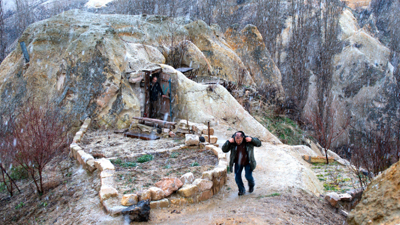
His latest takes place in mountainous Cappadocia, in Central Anatolia. It is a rugged, ancient country, famous for its wild horses. In a rare moment of action, Ceylan shows a herd of these rumbling across the steppes, though for the most part his film is static, deliberately framed, and concerned with teasing out rankling bitterness over injustice as ancient as the land itself.
At the center of Winter Sleep, and present in all but a handful of its scenes, is Aydin (Haluk Bilginer). He is a perpetually rumpled middle-aged man whose shabbiness belies the fact that he is one of his village’s leading citizens, which is not at all the same thing as being one of its best-liked. Our first indication of this fact comes when the small son of one of his humiliated tenants chucks a rock into the window of his jeep.
Aydin lives in a sort of self-styled gentryman seclusion with his divorced sister, Necla (Demet Akbağ), and his wife, Nihal (Melisa Sözen), who appears to be half his age. He has converted his late parents’ home into a hotel called “Othello,” a nod to his previous career as an actor. But while Shakespeare will later be cited at a key moment (“Conscience is but a word that cowards use …”) and jealousy is certainly among the subterranean emotions at work here, the principal influence, as ever with Ceylan, is Chekhov.
Held apart from the common life of the villagers around them — Aydin prefers to address them through condescending op-eds for a local newspaper, while Nihal’s philanthropy cannot undo her status as an outsider who doesn’t understand the stubbornly prideful ways of these people — the three have no one to turn against for sport but one another. This they do, like caged animals, though their violence is almost entirely of the psychic variety.
Winter Sleep, which Ceylan co-wrote with his wife, Ebru Ceylan, his co-star in 2006’s Climates, is his most dialogue-heavy film, full of discourses on morality, conscience, self-justification and self-recrimination. To return to Chekhov, the proverbial rifle over the mantelpiece is never fired — but Ceylan keeps you ever aware of its cocked-and-loaded presence.



