
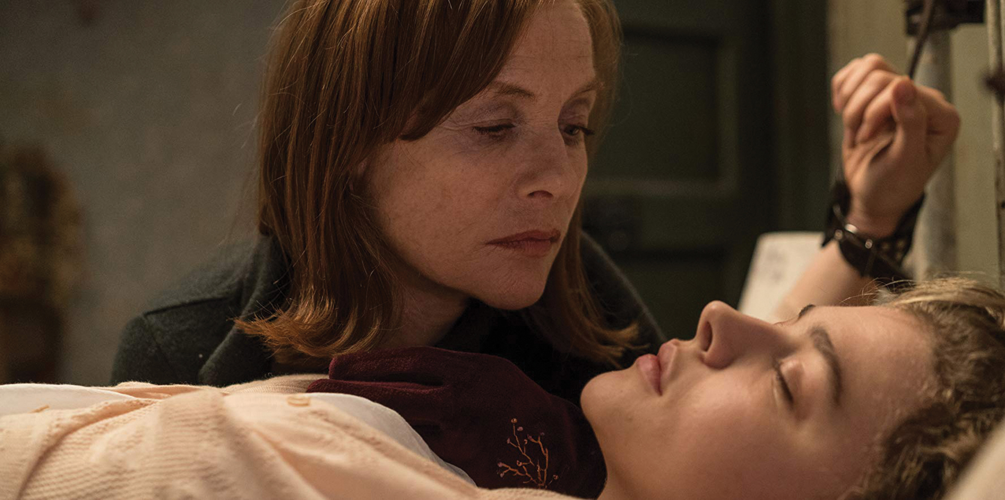


Greta (played by the peerless Isabelle Huppert) is a lonely older woman, a retired nurse languishing in a sumptuous Brooklyn apartment as she laments the absence of her deceased husband and Parisian-transplant daughter. Greta is a women of refined and peculiar tastes, playing games throughout the five boroughs and bringing countless lives into a twisted web. And Greta is the new film from Neil Jordan (Interview With the Vampire, The Crying Game) — it’s a fearless bullet train that knows you’ve seen mysteries and thrillers enough, making sure that by half-an-hour in we’re already careening into unexpected territory.
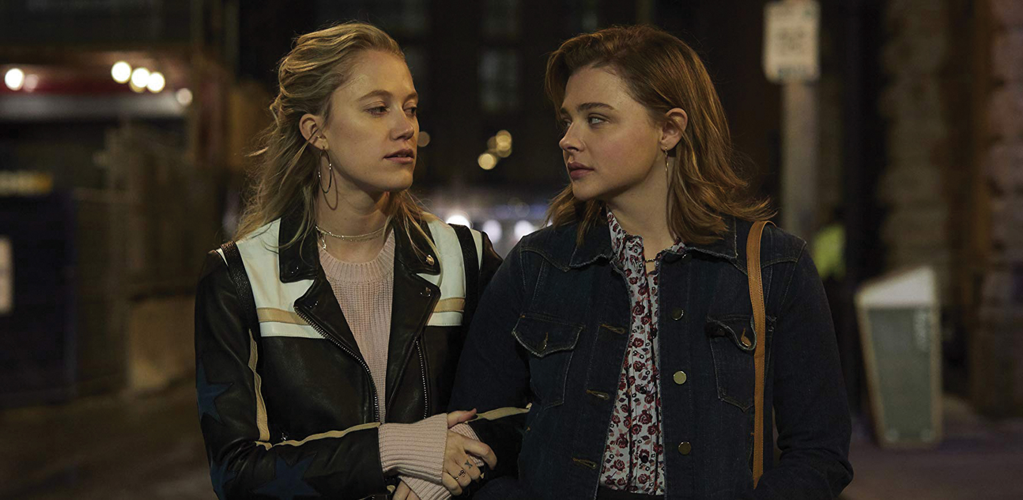
Frances (Chloë Grace Moretz), still adrift from the death of her mother a year prior, lives in the back room of her best friend Erica’s Tribeca loft. Erica is a rich kid with an obscenely luxurious apartment, and while it would be easy to hate her, we don’t. That’s because she’s played by Maika Monroe (The Guest, It Follows), who does enough emotional heavy lifting to let us see Erica as an actual person rather than a signifier of excess. And when Frances befriends Greta after finding her handbag on the 6 train, we begin to play emotional table tennis between Frances’ need to be a kind and decent person and Erica’s suspicious isolationism.
We know before the movie even starts that Greta is up to something, but the time the film spends on human interaction and outreach is necessary, because once it tilts into stalking/confronting/workplace trauma, it simply doesn’t stop. It’s like the second half of Jaws, but in austere dining rooms, crosstown buses, serpentine subway routes, and bars packed with hundreds of witnesses who won’t see what happened to you.

We get traditional stalker archetypes, but the film is also interested in the “other mothers” of classic fairy tales and Matthew Bright’s masterful Freeway films, full-on DePalma freakouts, the paranoid panic of early Polanski, and the sensual nightmares of Claire Denis at her darkest. Jordan, an absolute master of genre fare when he decides to get down and dirty, hasn’t been this deliriously entertaining since 1999’s little-seen masterpiece In Dreams. He’s got a superb cast and a willingness to go there, and in New York he has a space for this knife-sharp nightmare to unfold. There’s one image, early on, in which Frances and Erica have gone to the movies, watching something in 3D — the camera (manned by Seamus McGarvey, who shoots all of Steve McQueen’s films) catches the subtle magenta and green tones buried within those RealD glasses, not quite opaque enough to conceal the tears spilling from Moretz’s eyes. It’s an image that feels as iconic as J.R. Eyerman’s 1952 photo of the audience watching Bwana Devil In 3D.
And then there’s Huppert, who is simply everything in this film. Utterly fearless and operatic, she riffs on countless archetypes, deploying kindly old dog-park lady and Magyar maitresse with ease, even bringing her Erika Kohut from 2001’s The Piano Teacher back into rotation during this film’s welcomely brisk 99 minutes.
For potential viewers who’ve dealt with stalkers and emotional hostage-taking, this isn’t a therapy session, and I wouldn’t recommend it to folks working their way through their own trauma. This is a wicked film with a lot on its mind. But for anyone looking for a relentless suspense thriller with intelligent characters and a lush sense of visual pleasure, Greta is a miracle of mid-budget studio filmmaking. It’s the most entertaining and delirious thriller in ages.



