

After viewing Miroirs No. 3, I get the feeling Christian Petzold is ready to go Hollywood and make some old-school melodramas.
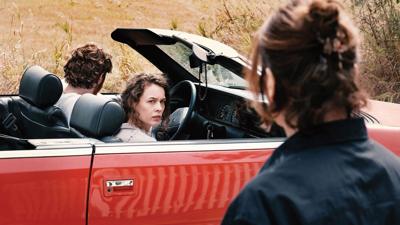
Predominantly set in the German countryside, Miroirs sees writer-director Petzold once again teaming up with actress Paula Beer, making this the pair’s fourth collaboration. This time around, Beer plays Laura, a young woman who’s in a car accident that kills her boyfriend (Philip Froissant), who was driving. Bruised but not broken, she rests and recuperates at the nearby home of Betty (Barbara Auer), a kindhearted middle-aged lady who nurses her back to health.
Laura begins to make herself at home, helping her host by cooking, cleaning and even painting Betty’s picket fence with her. But when Laura meets Betty’s estranged husband (Matthias Brandt, giving Chris Cooper energy) and son (Enno Trebs) — both mechanics who seem concerned about Betty’s well-being — Laura starts to sense Betty might have some traumatic issues of her own.
Although it’s named after the third movement in Maurice Ravel’s Miroirs suite, this is also the final installment in an elemental trilogy that Petzold began with the water-heavy Undine in 2021 and the blazing Afire in 2023. For Miroirs, it’s all about the wind — and although we get shots of curtains delicately swaying in the breeze, the characters still have a hard time clearing the air.

German director Christian Petzold’s latest opens this week at the Belcourt
Apart from the opening minutes before the crash — when we see a despondent Laura ruining a getaway she and her boyfriend were having with friends — not much is divulged about Beer’s character, though we slowly learn that Laura is studying piano. Although her character is written as an emotionally ambiguous blank slate, Beer maintains a sympathetic presence, even when she admits she’s not exactly mourning the loss of her significant other. (Considering the movie’s 86-minute run time, I’m gonna assume Petzold cut out a lot of Laura’s backstory.)
Betty and her brood also silently deal with grief. Auer, Brandt and Trebs do quietly devastating work as ordinary people attempting to become a loving family unit again, even when they know welcoming this new gal into the fold won’t bring things back to normal. By having the menfolk repair items in Betty’s house that have been on the fritz, Petzold really lays on the metaphorical emphasis — this clan needs to come together and fix their broken relationship.
Petzold has said in interviews that Alice in Wonderland was an influence on Miroirs, with Beer’s protagonist passing through the looking glass (a fancy term for mirror, naturally) and taking a spirited journey that could be cut short by that bucket of cold water known as reality. I’ve already seen a critic or two compare Miroirs to Cinderella, another fairy tale about a gal who escapes her miserable existence to briefly become the belle of the ball. (And it’s true that Laura is found missing one shoe after the car wreck.)
But I feel Petzold is also giving a shoutout to David Lynch’s Mulholland Drive — another film about a woman named Betty (Naomi Watts) looking after a brunette (played by Laura Harring) who was in a bad auto accident. And of course, since Lynch’s fascination with The Wizard of Oz is well-documented (perhaps you’ve seen the documentary Lynch/Oz, which played at the Belcourt last year), let’s throw L. Frank Baum’s iconic fantasia into the influence stew. After all, isn’t this family just a trio of lost souls hanging onto a girl who’ll hopefully help them find some heart, brains and courage?
Despite its persistence in keeping things unspoken right down to its final minutes, Miroirs No. 3 is still the most accessible film out of Petzoid’s triumvirate. I can see this film being a favorite for both cineastes and moviegoers looking for a good cry. It reminds me of those tearjerking, family-drama features Hollywood used to make before clogging multiplexes with the latest hot IP. I could imagine this movie getting remade for American audiences, with an A-list cast and a lot more weepy moments. (Petzold, being the subdued German he is, keeps the waterworks to a minimum.)
Unfortunately, these days those types of stories are usually stretched out into eight-part prestige series on streaming platforms. But if studios ever come around to making those films again, I’m pretty sure Petzold wouldn’t mind coming to America and taking a crack at it.



Post a comment as anonymous
Report
Watch this discussion.
(0) comments
Welcome to the discussion.
Log In
Welcome to the discussion.
Keep it clean. Please avoid obscene, vulgar, lewd, racist or otherwise abusive language. Comments featuring hate speech or threatening or violent content will not be tolerated.
PLEASE TURN OFF YOUR CAPS LOCK.
Be truthful. Don't knowingly lie or mislead.
Be proactive. Use the “report” link on any comment that violates our comment policy.
Share with us. We'd love to hear your feedback.