
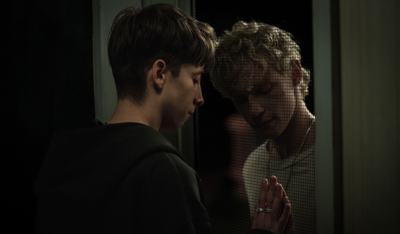

A film that wants to be several different things to a lot of different people, Leviticus has a killer hook: someone relentlessly pursued by a pitiless and cruel entity clad in the guise of whatever their fondest desire is. And because the focus of this film and this being is queer Australian teens, we’re seeing something that we don’t often see in genre cinema. The preferred mainstream conversion narratives tend toward inspirational drama or documentary — either something to be endured and triumphed over, or something to be depicted in order to foment rage. And whatever its relative strengths and weaknesses, Leviticus is not about an easy or clear narrative.
In a desolate stretch of Australia — equal parts industrial decay and strip mall economics — new kid Naim (Joe Bird from Talk to Me) and local floppy-curled scofflaw Ryan (Stacy Clausen) have tumbled into the back-and-forth of something like a high school relationship. They hang out, they explore the weird landscapes around them, they throw rocks at each other (which is certainly a way of co-opting the language of the oppressor), and occasionally they kiss. It’s all very drenched in golden-hour possibility, with that subtle tinge that colors all those feelings with operatic intensity while at the same time holding back … because it’s no big deal, dude.
But it is a big deal, both to the town’s religious folk (a fascinating amalgam of dreary sub-Hillsong Protestant music, fellowship hall collectivism and Breaking the Waves-style absolutism that feels tapped into something far older than beige-storefront Christianity) and to queer audiences watching this film — though for completely different reasons. The signs of queerness require intervention, whether it’s something like speech therapy or something like the mysterious “faith healer” who undertakes a simple but deeply unsettling ritual that sets this whole endeavor in motion.
One of the most heartwrenching lessons that any queer person learns is that not everyone in the alphabet family is necessarily on your side. In a just world, you’d see LGBTQ people like Peter Thiel and Sam Altman using their billions to help instead of burning the world. And that’s part of the thread woven through this film’s horrors — an unfixable fracture that tears apart families and relationships because the only way this curse can end is in death … and that’s a really fucked-up message for Pride Month. But it’s also a lesson most people are aware of just by looking around; any sort of social acceptance proves conditional, all too eagerly wrenched back if the prevailing winds decide to embrace something crueler and lazier.
Whatever they tell themselves their motivation is, parents who want their queer kids to be “normal” really just want things to be easier for themselves, rather than wanting to change the world and customs that they’ve lived in and benefited from. That isn’t a surprise when you look around and see organizations that claim the name and message of Christ to justify their grifting, lies and cowardice — and it makes things much easier for those organizations to simply not have any form of other around. There’s a big moral uncertainty at the center of this film, and writer-director Adrian Chiarella is doing an impressive tap dance to keep us guessing what the inciting horror at the heart of this film is — whether it’s the mere existence of these teens in this community, the betrayal of a child by their parent, or the betrayal of a jealous onlooker.
This is an untenable foundation, because if you’re going to structure your story in a way that puts these three things on the same moral footing, that’s fucked-up. Chiarella seems to care for Ryan and Naim, but the journey of this film is exacting and a lot to process. It doesn’t feel conventional in structure or narrative, and yet there’s an infuriating gay-bashing that inspires anger at the cliché rather than what it is and what it represents.
Bird and Clausen are both very good, and Chiarella has an unconventional approach that does an effective job of keeping the viewer off balance. Among Australia’s current queer horror vanguard, he’s not a poet like Nicholas Verso or a conductor of emotions like Alice Maio Mackay. (The latter’s 2022 film Bad Girl Boogey accomplishes a lot of what Leviticus serves up but with a more clarified rage and razor-sharp focus.) But Chiarella is certainly making an auspicious debut on the global cinema stage. There’s a choice made at the end of the film, however, that almost derails the whole thing; either this is a closed system or an open one, and the film’s unwillingness to commit either way robs it of myriad strengths.
For all my issues, Leviticus is a film that finds the tender and vulnerable parts of the brain and drives unpleasant thoughts directly into the electrified goo therein. It eschews anything coming close to a binary, qualitative response and instead keeps you up at night for too many disparate reasons. “Disturbing” is one of those words that can encompass everything from snuff reels to Project 2025, and it is a word that encompasses Leviticus and its hits and misses perfectly.





Post a comment as anonymous
Report
Watch this discussion.
(0) comments
Welcome to the discussion.
Log In
Welcome to the discussion.
Keep it clean. Please avoid obscene, vulgar, lewd, racist or otherwise abusive language. Comments featuring hate speech or threatening or violent content will not be tolerated.
PLEASE TURN OFF YOUR CAPS LOCK.
Be truthful. Don't knowingly lie or mislead.
Be proactive. Use the “report” link on any comment that violates our comment policy.
Share with us. We'd love to hear your feedback.