

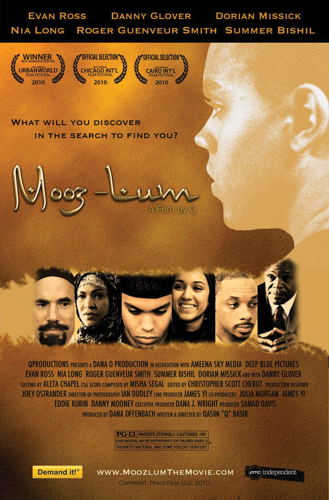

Director-screenwriter Qasim Basir certainly understands the fear and loathing some Americans have for Muslims, attitudes that intensified in the wake of 9/11 and flared as recently as last week in the Tennessee legislature. But he didn't make his acclaimed film Mooz-lum just in response to those sentiments.
"I wanted to put a human face on Muslims and Islam, show audiences the humanity that has often gotten lost in what they see in film and on television," Basir said. "We get a lot of terrorists and suicide bombers, but we don't see regular people, families struggling to make it just like everyone else. That's what I wanted to do with Mooz-lum, show what real life is like for so many Muslim families in America."
Mooz-lum, which makes its Nashville premiere 5 p.m. Saturday at Belmont's Troutt Theatre, is partly autobiographical. Its portrait of a strict Muslim family and a young black man studying to be a Qu'ranic scholar (a hafiz) prior to attending college mirrors Basir's upbringing. Boasting a stellar cast that includes Danny Glover, Nia Long, Roger Guenveur Smith and Dorian Missick, the film delves into lifestyle differences and the harassment Muslims often encounter in neighborhoods, schools and other social hubs.
Basir, a first-time feature-film director, says he relished collaboration with his veteran performers. "I was working with a cast that ranged from people whom I've admired for years to others who were like myself, with very limited experience" he says. "There were many times when they would come to me with excellent suggestions. Nia, for example, is a mother. When she came to me and said, 'As a mother, I wouldn't say this,' we would often make that change. Other times we might keep the original lines, but it would always be after we considered everyone's input into the character and reaction to the scene or situation."
The opening entry in the International Black Film Festival of Nashville's summer season, Mooz-lum is also part of a growing movement among African-American filmmakers to avoid distribution politics and instead take alternative cinematic messages directly to the audience. Prior to Mooz-lum's opening in 10 select cities in February, the filmmakers launched a social networking campaign to alert audiences to the movie's theme. Reviews and comments can still be posted on their Facebook page. The producers have since handled marketing and distribution duties, something veteran producer Dana Offenbach acknowledges poses quite a challenge.
"We knew this would be a major step, but I don't think we anticipated how much work was involved," Offenbach says. "But everywhere we've shown it, the reaction and response has been great. We can sit and debate all night why only certain types of films on the black experience seem to be big sellers, or why the major studios are mainly promoting one type of film to certain audiences. But the bottom line is the only solution right now is the independent market, then locating people who want to see these films and making sure they have that opportunity."
With a DVD campaign set to launch next month, Basir and Offenbach feel confident the combination of mostly positive reviews and word of mouth will ensure additional success for Mooz-lum. "I'm already working on my next project, which will be something very different, but I'm still very much committed to this film," Basir says. "I just wanted to tell another type of story. We're not condemning or attacking anything else that's out there, just giving audiences something else."
Mooz-lum shows 5 p.m. May 28 at the Bill & Carol Troutt Theatre, 2100 Belmont Blvd. Qasim Basir and Dana Offenbach will conduct a Q&A immediately after the screening. Tickets are $12, $8 for students with ID. For additional information, contact www.ibffnashville.com.
Email arts@nashvillescene.com.



