
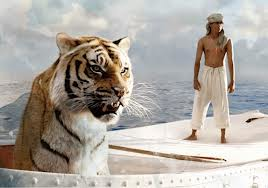
The blatantly allegorical significance of Life of Pi’s episodic narrative is sure to make suspension of disbelief an issue for some of viewers. But it’s to the great credit of director Ang Lee (Brokeback Mountain, The Ice Storm) and screenwriter David Magee (Finding Neverland, Miss Pettigrew Lives For a Day) that their adaptation of Yann Martel’s award-winning and best-selling novel is as disarming as it is. There’s an ease and a genuine sense of wonder to the film’s black-light picture-book grandiosity that makes Martel’s sometimes strained narrative a non-issue.
In many ways, the film’s abundant sense of awe stems from Lee and Magee’s fascination with their story’s animal protagonists. Life of Pi handily elicits the same sympathy and curiosity that you feel when you visit the zoo to gawk at the resiliency and variety of the animals on display. Thankfully, it’s a lot easier to be inspired by animal-filled tableaux vivants than by a dry sermon that happens to feature animals.
Life of Pi’s narrative begins as a story. An adult Pi Patel (the honey-tongued Irrfan Khan) recounts to a man only identified as a writer (Rafe Spall) a long story about his life. Growing up in a zoo in Pondicherry, a young Pi (Suraj Sharma, in his accomplished debut performance) travels to America with his family by freighter. A freakishly strong storm causes their ship to capsize. The only survivors are Pi, a Bengali tiger, a zebra, and a hyena, all packed into a curiously accommodating lifeboat.
Lee and Magee are thankfully just as invested in relating the immediate dangers that Pi routinely faces post-storm as they are in using episodic vignettes to establish Life of Pi’s spiritual thrust. This is especially striking since Life of Pi’s epilogue establishes in no uncertain terms that we, as recipients and active builders of Pi’s story, are more willing to accept a sad story that’s primarily concerned with the grisly material details of its protagonists’ survival.
But the rest of Life of Pi’s plot simultaneously confirms and refutes that concluding sentiment. Pi’s story only grows more engrossing as it goes on because watching Pi struggle to stay alive makes it possible for us to believe in Pi’s character-defining moral introspection. In other words, we need to first be engrossed in scenes where Pi learns how to fish and to avoid being eaten by Richard Parker, the ravenous Bengali tiger, in order to believe as Pi does that there is more to life than sheer animal instinct. You can’t find the nobility of the human spirit in Life of Pi without first believing in the amorally savage will to live.
Here Lee and Magee’s abundant love for animals really saves the day. Life of Pi is and isn’t a film for the whole family because its creators are fascinated by the tic-like mannerisms that typify their animal protagonists. While he’s only in one or two scenes, the hyena in Pi is probably more well-developed as a character than most other human protagonists in this year’s bumper crop of award’s season dramas. That Doolittle-like fascination with the way animals adapt to their surroundings is crucial. Without that basic recognition, it becomes impossible for viewers to see these animals as anything more than fever dreams that Pi uses to transform his life’s tragic events into a faith-testing spiritual quest.
Thankfully, Lee and Magee only infrequently strive for a level of significance that they fail to achieve, as when Pi discovers a free-floating island where fresh water pools mysteriously transform into acid pits over-night. But for the most part, Life of Pi’s parade-float-sized ambitions usually match its creator’s means. Come for the animals, stay for the gnostic speculation.



