

There have been tons of essays, commentaries and news stories about Muslim jihadists and the terror and oppression that is their trademark. But Abderrahmane Sissako's brilliant, at times chilling and disheartening masterpiece Timbuktu, which opens Friday at The Belcourt for a one-week run, provides a powerful cinematic portrait of the chaos that is religious fundamentalism run amok. Sissasko's fourth feature portrays one of the world's grand ancient cities ravaged by zealots determined to impose a warped interpretation of Allah's will.
Sissako doesn't depict these so-called religious warriors as inhuman caricatures, however — far from it. As upholders of Sharia strictures not even they can completely meet, the soldiers in Sissako's film are increasingly incapable of compromise, and what could be more human than relying on zealotry as a default position? They want music banned, art treasures destroyed and women kept subservient in the name of holiness and purity. They see all life situations as absolutes, and anyone who doesn't echo their beliefs is an infidel to be punished, if not outright eliminated.
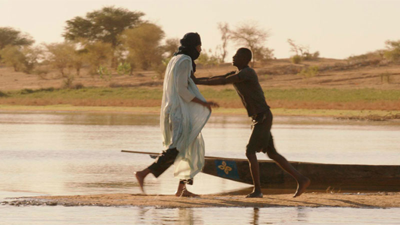
But the film isn't just a polemic against intolerance. The story focuses on Kidane (Ibrahim Ahmed), the patriarch of a cattle-herding family in the dunes outside Timbuktu, which Islamist forces overran during the civil war in northern Mali in 2012. He finds himself in the crosshairs of the jihadists' judgment following a bitter conflict with a local fisherman over the killing of a cow — a clash that ends in violence all the more upsetting for its abruptness, and the serene natural beauty within which Sissako frames it. Kidane is steadfast in his belief that what he did is right; his faith is contrasted with that of the jihadists, both sides utterly convinced they and they alone know the truth.
So too does Sissako juxtapose Kidane's act of violence — a crime in the heat of anger — with the deliberate viciousness of the jihadists, who dole out harsher and harsher punishments (including a stoning) under the cold guise of order. That order isn't just religious — it's social. Keeping women in their place is never far from the soldiers' minds, whether they're policing hand coverings or forcing a young woman to marry one of their own. The movie offers many incongruous images of old and new in collision: motorcycles roaring through ancient streets, a villager in boldly colored garments blocking the path of a military vehicle. As an attempt to turn back the inevitable onset of modern changes, the jihadists' cruelty seems as futile as it is brutal.
Yet Sissako lets glimmers of the soldiers' humanity shine through, using his cool, contemplative style to convey the emotional tension of people constantly reconciling illogical actions through inflexible belief. This is especially true of jihadist leader Abdelkrim (Abel Jafri, in a nuanced performance), whose inability to act completely like a soulless martinet — as when lusting after Kidane's disarming wife Satima (Toulou Kiki) while reading her the riot act for not covering her face — bespeaks a hint of compassion, even envy.
Timbuktu isn't anti-religion, but it sees religious extremism as an agent of destruction, not restoration. It's another reminder that radical fanatics, whatever their ideology, are ultimately much more concerned with their own power than any deity's. Sissako, himself a Muslim, suggests that if there's an antidote to the jihadists' dogmatic tyranny, it's the lilting, soulful Malian music that sustains his characters even when they're being beaten for it. As Americans know from their own struggles, there is no force so liberating as the freedom to sing the blues.
Email arts@nashvillescene.com



