

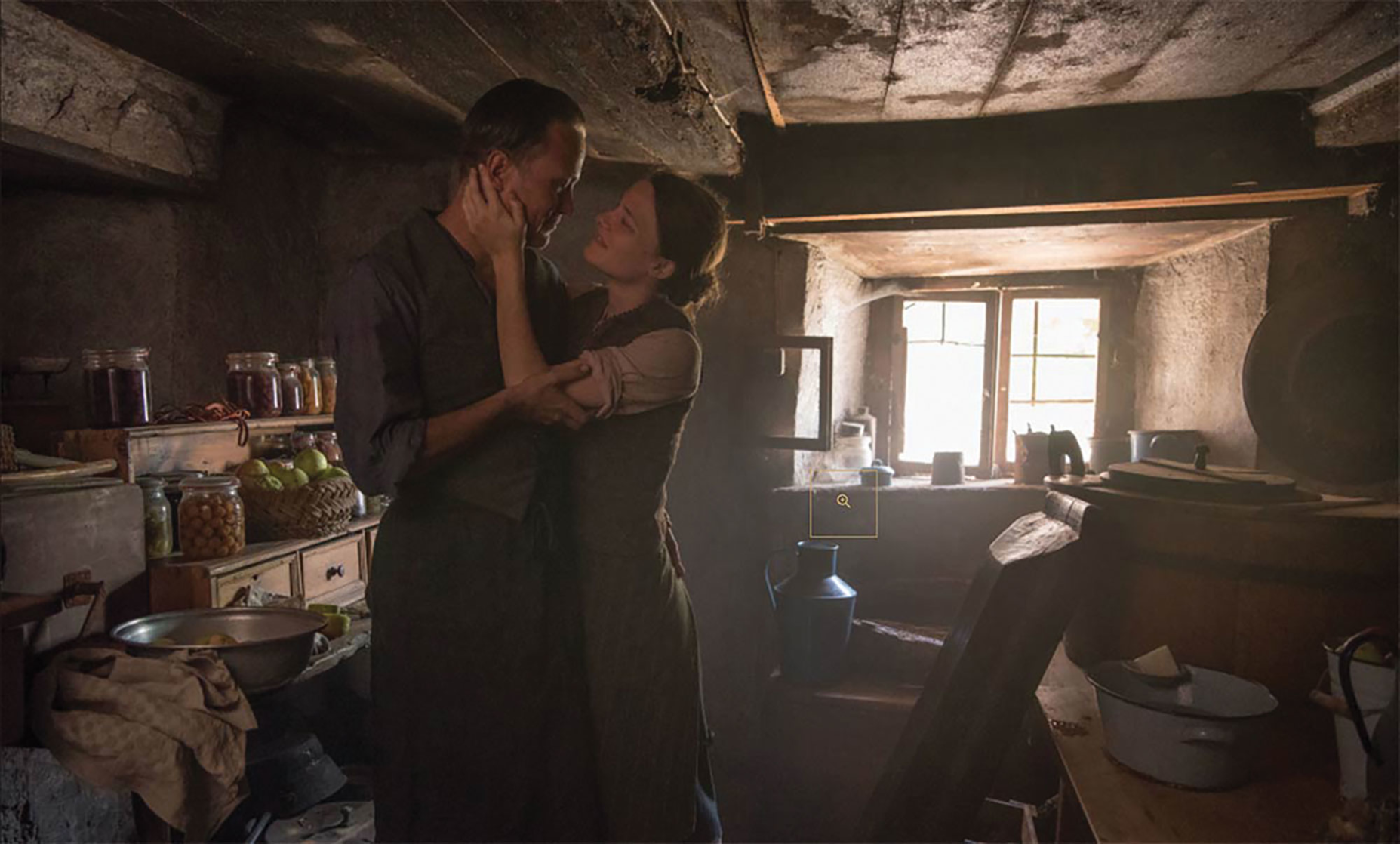
There’s been some talk that Taika Waititi’s recent satire Jojo Rabbit — a cute, enjoyable film, to be sure — undersells the horrors of the Third Reich, depicting Nazis as a bunch of goofy knuckleheads worthy of derision. Well, gifted auteur Terrence Malick’s A Hidden Life takes the antithetical approach: This is a film in which the true stakes of the Third Reich’s brutal fascism are made plain, and put in a context that forces us to ask ourselves just how far we’d go to do the right thing.
A Hidden Life centers on a peasant farmer in World War II Austria who quietly resists the brutal march of fascism by abstaining from military service and refusing to swear allegiance to Hitler. Based on the true story of Austrian conscientious objector Franz Jägerstätter, the film’s 174 minutes are littered with the long and languid sequences for which Malick is known. The bucolic opening shots featuring Franz and his family are set against the Austrian Alps. It’s here that we see Malick’s unparalleled ability to make the intimate seem grand, to project small moments in a manner that makes them feel as big and meaningful as any global conflict: a father holding his newborn child; the flirtations between a husband and wife; the difficult, honest work of maintaining a farm. But of course, war comes calling in 1940, and Franz — played with a powerful, quiet dignity by August Diehl, whom most viewers will recognize as the basement-tavern Nazi officer from Quentin Tarantino’s Inglourious Basterds — must ship off to basic training.
Franz and his wife trade letters as he trains. “Oh my wife, what’s happened to our country?” he asks as he sees Hitler’s hordes conquer France. “To the land we love?” After he returns home from training, Franz confides in his priest that he can’t square his faith with the actions of the Axis powers. Franz refuses state subsidies, and refuses to contribute to the veterans’ fund. Little by little, the consequences of his moral objections grow larger. “Your sacrifice would benefit no one,” Franz’s priest tells him. It’s a sentiment that’s echoed frequently over the course of the film by those who would have the farmer abandon his moral stance and take up the fight — that his actions here are meaningless, and that Franz is doomed to have no legacy.
Particularly in his work post-The New World, Malick isn’t big on fleshing out his scenes with meaningful dialogue or clearly outlined plot points. Rather, he creates series of vignettes, many of them featuring long stretches of silence, allowing his actors to play off one another as well as their surroundings. It can be a frustrating kind of filmmaking, especially in the case of a movie like 2017’s Song to Song, in which the stakes and, indeed, the plot are nebulous. Here, however, the power of the approach serves the story well — the stakes for Franz are life and death, and Malick’s remarkably slow pacing allows the pressure to mount to an almost unbearable degree.
Franz and his family are punished physically and psychologically for the patriarch’s decision. “Better to suffer injustice than to do it,” Franz’s father-in-law says at one point. And that is indeed the simple but potent thesis of the film, which takes its title from the closing passage of George Eliot’s Middlemarch: “The growing good of the world is partly dependent on unhistoric acts; and that things are not so ill with you and me as they might have been, is half owing to the number who lived faithfully a hidden life, and rest in unvisited tombs.”
Thankfully, the sacrifice of Franz Jägerstätter did not go unnoticed. His wicked and cynical oppressors were wrong about that, as they were about so much. Malick knows the power of letting a deeply selfless act speak for itself, and if you have the patience for A Hidden Life’s cinematic indulgences, you’ll find yourself rewarded.



