


Comics who have an inflated sense of their craft’s ability to effect political change like to allude to a quote Mel Brooks made a number of years ago in a German newspaper: “By using the medium of comedy, we can try to rob Hitler of his posthumous power and myths.” But it’s been more than 50 years since Brooks & Co. first serenaded us with “Springtime for Hitler,” and it’s tough to imagine anyone taking the piss out of the Nazi Party better than The Producers.
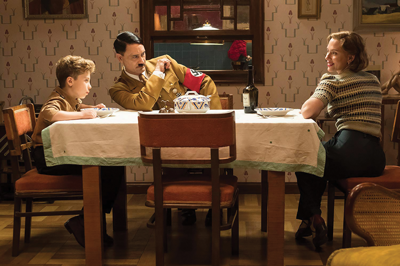
Such is the dilemma faced by Taika Waititi, a very well-intentioned Kiwi filmmaker who sets his satirical sights on that mustachioed mass murderer with his new film Jojo Rabbit. Newcomer Roman Griffin Davis plays the titular Jojo Betzler, a dew-eyed Hitler Youth member who loves the Party so fervently that Adolf Hitler (played, of course, by Waititi himself) is his imaginary best friend. Jojo’s fanatical but not quite fully formed political beliefs are put to the test when he discovers that his mother — played by Scarlett Johannson, who would be more believably cast to me as a Nazi than a resistance fighter — is hiding a Jewish girl named Elsa (Thomasin McKenzie) in the attic. Rounding out the supporting cast are Sam Rockwell, who parlayed his Three Billboards Oscar into a career playing racists, and Rebel Wilson, who Hollywood is still trying to tell me is funny even though she’s never made me laugh.
Waititi — whose previous work includes What We Do in the Shadows, Hunt for the Wilderpeople and Thor: Ragnarok — is, at the very least, one of the few contemporary comic filmmakers who finds humor in his visual sensibility, rather than just in the performances of his actors. His brand of comedy is squarely deadpan, with a splash of kid-friendly whimsy, but it owes less to the influence of Wes Anderson and more to Jared Hess, the underrated auteur behind Napoleon Dynamite and Nacho Libre. Unfortunately, there’s only one joke in Jojo Rabbit — Nazis say the darndest things! — and it gets old fast.
The film’s farcical take on the Third Reich feels akin to centrist critiques of Trump — like Trump, who is mocked more often for his hair and penchant for McDonald’s than his actual policies, the Nazis of Jojo Rabbit are bad less because of what they believe and more because of how they believe it. The opening-credits sequence remixes footage from Triumph of the Will and sets it to the Deutsch-language version of “I Wanna Hold Your Hand” that The Beatles recorded for the German market. It’s a sort of bargain-bin version of the political analysis British documentarian Adam Curtis mines from pop music. This is Waititi’s main line of critique: Nazism as a kind of especially pernicious stan culture, its infantile practitioners the original teenyboppers.
Waititi’s target isn’t the public fanaticism of Nazi Party members but fanaticism itself — the gaudy costumes and rallies full of screaming children, for instance. You can’t reform a Nazi through argument alone, so Waititi opts for the second-best thing: telling Nazis they’re ugly and childish until they start crying about how they’re not ugly and childish and eventually give in. It’s a little bit like the approach taken by comedian Nathan Fielder in a Season 2 episode of Nathan for You, when he markets an unsellable toy by telling children that owning it is the only way not to be a baby. The central Nazi in Jojo Rabbit is a child because in the film’s eyes, all Nazis are children with childish beliefs, and no child wants to be thought of as a baby.
But the Nazis weren’t children, and Hitler wasn’t a buffoonish imaginary best friend: They were adults, and as adults do, they committed genocide in a clinical and methodical way. That’s the real horror of the Holocaust — not that its perpetators sometimes wore funny hats, but that they were mature adults who turned ethnic cleansing into an assembly line and made the murder of millions a profitable business.
The film’s most crucial line comes when Jojo proclaims that he’s a Nazi and Elsa tells him that he’s not — he’s just a silly little boy who likes to put on a costume. In regard to children mimicking beliefs that they may not have the capacity to fully understand, I get what Waititi means. But this line of thinking seems a little dangerous when literal Nazis are involved. If there’s anything we’ve learned from the current shitstorm of American political life, it’s that when someone starts wearing swastikas in public, you probably shouldn’t doubt the sincerity of their beliefs.



Post a comment as anonymous
Report
Watch this discussion.
(0) comments
Welcome to the discussion.
Log In
Welcome to the discussion.
Keep it clean. Please avoid obscene, vulgar, lewd, racist or otherwise abusive language. Comments featuring hate speech or threatening or violent content will not be tolerated.
PLEASE TURN OFF YOUR CAPS LOCK.
Be truthful. Don't knowingly lie or mislead.
Be proactive. Use the “report” link on any comment that violates our comment policy.
Share with us. We'd love to hear your feedback.