
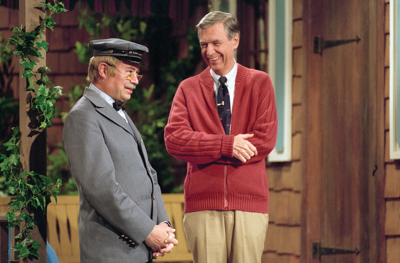


Whether or not you’ve ever lent them any credence, you’ve almost certainly heard the rumors over the years. Fred Rogers was a Navy SEAL. Or maybe it was an Army Green Beret. Or rather, perhaps he was an ex-con, with prison tattoos covering his arms and torso.
The longtime host of beloved public-television institution Mr. Rogers’ Neighborhood never served time, either in the military or in the clink. And as you can see in a 1982 episode of his program — an episode in which Rogers shows viewers his daily swimming routine — he didn’t engage in any body modification. At least, not in any that was visible outside of his swimsuit region. So why the rumors? As one interviewee points out in the new documentary Won’t You Be My Neighbor?, perhaps it was because people often don’t think any human being could possibly be as earnest, as caring and as genuine as Fred Rogers’ persona made him appear to be. But as the film makes abundantly clear, he was.
Prolific documentarian Morgan Neville is likely best known for his Oscar-winning 2013 doc 20 Feet From Stardom, which followed the careers of backing vocalists like Darlene Love and Judith Hill. Here, rather than shining a light on undersung performers, Neville turns his camera on the inner life of a figure who spent decades on television screens all across the country. From Rogers’ sickly childhood — some of which is depicted in animated segments — to his work as a scholar of childhood development, Neighbor provides deep context for the pioneering broadcaster’s guiding philosophy.
For those of us who watched the program and internalized its messages but haven’t revisited in many years, there’s an element of Mr. Rogers’ Neighborhood that can be easy to forget: Rogers, an ordained Presbyterian minister, never shied from addressing tragedy and conflict. He knew that children were aware of events like Robert Kennedy’s assassination, the Vietnam War and 9/11, and rather than condescending to kids, sugarcoating world events or simply ignoring them altogether, he addressed them directly and with great care. A 1969 segment in which François Clemmons — an African-American who played a singing policeman on the show — soaks his feet in a kiddie pool alongside Rogers, complete with biblical undertones, is a particularly striking moment.
There are no bombshell moments in Won’t You Be My Neighbor? There are no big reveals or moments of controversy. Sure, there are glimpses at elements of Rogers’ personality we seldom saw on screen — his exacting nature as a creator, for instance, or how he reacted to criticism. But mostly, through glimpses of rare footage and a number of intimate interviews with friends, family and collaborators, the film is a long look at the depths of this deeply sensitive man’s love for children, and it’s done well and succinctly.
As it turns out, Fred Rogers was the real deal through and through.



Post a comment as anonymous
Report
Watch this discussion.
(0) comments
Welcome to the discussion.
Log In
Welcome to the discussion.
Keep it clean. Please avoid obscene, vulgar, lewd, racist or otherwise abusive language. Comments featuring hate speech or threatening or violent content will not be tolerated.
PLEASE TURN OFF YOUR CAPS LOCK.
Be truthful. Don't knowingly lie or mislead.
Be proactive. Use the “report” link on any comment that violates our comment policy.
Share with us. We'd love to hear your feedback.