
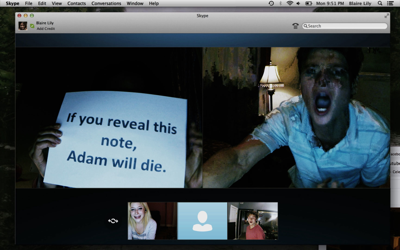


In its own way, Unfriended is going to be like The Blair Witch Project for a lot of people. There will be a great deal of “That's not a movie, and if that is then I'm done with the whole form” grumbling, and more than likely the old "death of cinema" canard will get trotted out in several online thinkpieces. Because the entire film — well, 99.7 percent of it — takes place on the screen of a computer belonging to Blaire Lily (played by Shelley Hennig), a Fresno student who, along with five of her friends, ends up in a Skypechat with a mystery ... on the one-year anniversary of the tragic suicide of a friend named Laura Barns.
“Weird computer shit happens to me all the time,” says Jess (Renee Olstead), a fun blonde with a great, sad smile. And in the age of the NSA, GamerGate and the Sony hacks, along with any of the random things that barely seem to register collectively in our datastreams, she's right. Stuff happens sometimes. But the stuff these young folk are dealing with is bringing a body count. In the way that all young contemporary life happens on video and across more and more social media platforms, so too will contemporary death — in violent bursts that coalesce from a pixellated miasma or pop into view from lost signals.
Back in 2003, Yusuki Saski's Tegami (The Letter) was composed almost entirely of text messages as sent and received on a cell phone. So it isn't like director Leo Gabriadze's computer-screen-bound mise-en-scene is an unheralded avant-garde gesture. But it certainly is a bold statement from a mainstream mall-bait release, and like Tegami, it finds riveting dramatic tension in the way that we reprocess and re-edit what we say when working in text-based speech.
In much the same way the Paranormal Activity films have turned the static frame into a source of ceaseless tension, Unfriended takes digital glitching and Skype refresh circles and turns them into the equivalent of the scary door in classic slasher flicks: What's behind that? What will be there when our eyes can adjust and finally we see? It even tweaks the opening studio logo with the slyest opening bit of foreshadowing since Alien3 refused to resolve the final note of the Fox fanfare, instead flattening it out into something unexpected and shocking.
At its best, Unfriended echoes Roger Avary's underrated The Rules of Attraction in its understanding of how everything in the adolescent mind can become grand opera in the haze of hormone flush, adult awareness, and impulses toward casual cruelties. At its worst, which is rare, it feels like reality TV outtakes, which somehow adds a convincingly fake verisimilitude to the proceedings. When it hits its peak — which is less a specific moment than a realization that comes to the viewer while watching it, it beckons you to face the absolute moral truth of yourself. To put it another way: If the last half hour of While We're Young is The New Yorker's version of Catfish, then Unfriended is MTV's version of the last 30 minutes of Mulholland Drive. When this film gets right down to it and starts laying waste to its cast, it traffics in a sustained and ridiculously violent counterpoint of wrenching emotional horror that just does not let up.
We never really get to know Laura Barns. We see her suicide video, and then the video that led her to kill herself. We see her Facebook page, and photos of her with friends, and the remnants of old eMails and YouTube posts. But we never get any sort of handle on who she was as a person, barring some offhand remarks from the knowledgeable fat friend (played by the awesome Jacob Wysocki, from Azazel Jacobs' film Terri). The force driving the engine of technology-based revenge personifies itself as this Laura Barns, but it's really just the collective awfulness of the group of people around her.
This isn't like the Saw films, where a fascist force attempts to both impose its will on those it deems inferior and to grant that same power to those who meet its initial criteria. But it's not like the Final Destination films either, where there is no moral continuum operating in the universe and all will die. This is something angrier, more primal, shrieking like a shakti and ready to settle scores, sprung from an unspeakable hurt and the same depths of cruelty it aims to punish, and gathering all information and technologies into an inescapable indictment of humanity.
There was a terrible film a few years back called Smiley that tried to do something along these lines, but it was hamstrung by two movie-killing things: the need for a likable protagonist, and an excess of dumb shit. You'll find neither of those things here. Unfriended is as if one of Louis C.K.'s bits about how technology has allowed us to become more ourselves — our venal, horrible selves — gained sentience and started eliminating people in accordance. It is a film of the now and highly recommended, either in a packed late-night screening (ideally opening weekend), or alone on a computer with headphones (when it hits VOD). This kind of fear encompasses many platforms — and it provokes, gleefully.



