
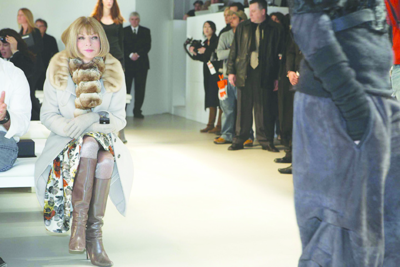
If you were hoping to unlock the mysteries of Vogue head mistress Anna Wintour, R.J. Cutler's The September Issue isn't talking. Shot over nine months in 2007, the documentary may grant the viewer lots of access to the making of the fashion bible's five-pound, 840-page 2007 September issue (the largest in its history), but not so much to its polarizing editor-in-chief. Instead, the bobbed and Wayfarer-wearing Wintour hovers safely in the front row, musing, eyeing incisively, rejecting or accepting, but never really playing her hand. But, oh, the clothes! The locations! The designers! The make-believe!
What one is certain of after 90 minutes is that the heartbeat of Vogue's pages—those lusciously shot spreads that seem plucked out of Dionysian dreamscapes—comes straight from the imagination of Grace Coddington, the former model turned creative director who started at American Vogue the same day as Wintour some 20 years back. It is together that the two's creative tensions—Wintour's shrewd, forward-charging eye and Coddington's gift for translating that dream world into woozily iconic, page-leaping concepts—have single-handedly shepherded the fashion world for decades. Or as publisher Tom Florio puts it, "If we get behind it, it sells."
What also sells is the image of Wintour as an ice queen and elitist—see The Devil Wears Prada, whose dragon-lady character Miranda Priestley is believed to be an acid-washed portrait of the imperious editor. See mid-'80s British Vogue, where Wintour's profound transformation and chilly manner led to the nickname "Nuclear Wintour." See a recent 60 Minutes interview with Morley Safer, where Wintour makes no bones about her disdain for fat people. (She also tells the cameraman in the documentary that he needs to go to the gym as casually as one might compliment a colleague's outfit.)
And The September Issue does help us understand that Wintour—the one who isn't trying to portray the world as it is, but rather as she thinks it should be—a little. She's a true study in the art of the climb. She has not just, from the start, made critical connections to the right designers, photographers, writers and models: she has sometimes discovered them and most times furthered their careers, as with John Galliano. And as a result—as the documentary reiterates—there is no part of the $300 billion dollar fashion industry she has not touched.
What is sometimes more fascinating than Wintour's persona is the fact that a public still uncomfortable with female power is so put off by it, seemingly asking her to be warmer, more inviting. But as Florio crisply explains, "She doesn't need to be accessible—she's busy."
Busy is the tone of The September Issue, which gives any fashion-minded follower an extraordinary look at the often mundane but always frenzied daily stomp toward deadline—only with tens of thousands of dollars on the line in every miniscule decision, from run-through to photo shoot to mock-up. Wintour, like a demure general, handles those tiny choices with utter surety. What isn't mundane comes across as absurd and inexplicable. One moment, a scarf that resembles a giant neck brace is laughed away; another moment is spent debating whether rubber is indeed a texture. (Watch for traipsed-in appearances from outsize personality André Leon Talley, editor at large, for comic relief.)
In the meantime, the minions come before Wintour with hands trembling or eyes wary. She tells her style director flatly that all her work is a predictable rehash, just as easily as she tells Oscar de la Renta that his other work is far more exciting. See Jean Paul Gaultier stutter nervously! They take her criticisms graciously, though the only one who seems unaware of the awkwardness is Wintour, who is too busy being placated by everyone she meets.
The only person who doesn't use kid gloves with her is Coddington. Though she spends a large part of the doc sulking about cuts made to those gloriously muted spreads, Coddington emerges as the only voice capable of challenging Wintour's view. "If you hate something," Coddington instructs Wintour point blank, "just say you never ever want to see it in the magazine." "OK," says Wintour hurriedly, as if ever doing otherwise was unthinkable.
Coddington's iconic genius is undisputed the world over. But Wintour, of course, still has final say over everything. Even after doing this dance, issue after issue, for some 20 years, Coddington is still saddened by watching her work slashed, and by seeing Wintour temper the dress-up box with a flick of the wrist. "I'm still a romantic, I guess," Coddington says about her pages.
Wintour may have trained a generation of celebrities to want to be supermodels by putting them on Vogue's cover. But it's Coddington's spreads that conjure the fantasy for all those women who grew up flipping lazily through the magazine's pages, dreaming of that make-believe world—the one where nothing or no one from our own world fits.



