
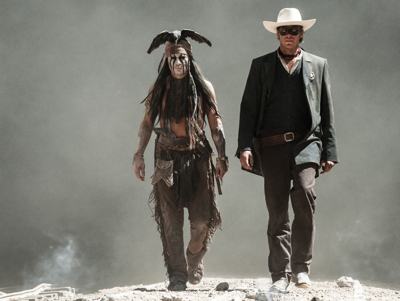

Not the kind of film you would expect to share its structure with 1955's Lola Montès — that is, equally sideshow-bound in melancholy reverie, with the grand affairs of history reduced to tableaux — The Lone Ranger is a big-budget summer tentpole film that seems rather eager to take a lot of chances. Easily half an hour too long and a bit too enthusiastic in trying to establish itself as a worthy successor to the Pirates of the Caribbean films (which it effortlessly eclipses in all ways), it nonetheless proves a strong rebuke to the summer movie culture of haters, who have been chomping at the bit for a film to serve as this year's John Carter. This won't be it.
Lawyer John Reid (Armie Hammer, with the exact blend of integrity, scruff and irresistible goofy charm that lets British guys be Doctor Who) is brought back from death to avenge a litany of betrayals — of his sheriff brother, of his beloved sister-in-law, of the Comanche nation, of thousands of railway workers, and of one particularly animated dead bird. He's not alone in this pursuit, as a Native American named Tonto is also aiming to take out the mysterious, murderous Butch Cavendish (William Fichtner) — who may also be a wendigo.
Johnny Depp's performance as Tonto walks a very fine line. Some would call it offensive or buffoonish — though anyone who saw Depp's shockingly under-seen directorial debut The Brave will know that Native American issues are very important to him. His Tonto seems much more couched in the tradition of Coyote, the Trickster, and to a lesser extent Pagliacci, the sad clown. He gets the best jokes because he's the star of the movie. But there's more going on with this performance than simple minstrelsy, because the legacy of collective and racial guilt suffuses this film in ways that should make for interesting discussion.
On the other hand, there's also a minor henchman (played by one of the Treadaways from Brothers of the Head) coded as sexual other out for cruel role play and rough trade for some reason, and it seems a gratuitous touch for a film otherwise very much interested in the mechanics of equality and justice. It screams of studio notes.
Like Despicable Me 2, The Lone Ranger uses carnivorous rabbits as a darkly humorous metaphor for the world spinning off its axis, but here we're left with no easy or foreseeable way to undo the damage. If elements of the film call to mind El Topo in its demonstration of spiritual crisis, then it also tips its hat to Chinatown as an evocation of the social and financial crises that still plague the nation. And as far as taking a quintessential American icon and putting it through the angst-o-meter to make it accessible to modern audiences — as is now the custom, thank you very much, Christopher Nolan — Gore Verbinski and crew do a better job with The Lone Ranger than the team behind the pleasantly weird but tonally insane Man of Steel did.
The production design is suitably strange, with the majority of scenes taking place in the grand wide open or on a series of increasingly stylized railway cars. A lush bawdy house is such a fusillade of color that its workers needn't show any skin at all; their use of hue and texture is a near-sensual riot amid the near-monochrome power of the desert frontier. Cinematographer Bojan Bazelli (Body Snatchers, The Rapture, Pumpkinhead) is one of the best in the business, and it's glorious to have his work back on the big screen. Likewise, it's refreshing that 2013 is turning out to be the summer where the biggest blockbusters made some of the weirdest choices. Here's to what the future may bring to this deliriously strange Western, and the passions that saw it through the decades to this latest incarnation.
Email arts@nashvillescene.com.



