
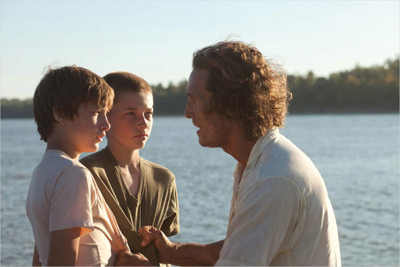

Mud, the opening night feature last week at the Nashville Film Festival, was a near-perfect attraction for a regional film festival. A moody, absorbing character study about two boys who befriend a fugitive (Matthew McConaughey), only to get caught up in a web of danger and violence involving his errant beloved (Reese Witherspoon), it's a mix of indie grit and pop entertainment, character actors and movie stars, long takes and confidently staged action. It builds its narrative momentum brick by brick from the interactions of its characters and the strength of its location shooting.
A lot of those qualities can be credited to writer-director Jeff Nichols, the Arkansas native who's one of the brightest talents to emerge from the Aughts' indie scene. His debut, 2007's Shotgun Stories, proved a calling card for him and solidified the rep of his remarkable leading actor, Michael Shannon; their follow-up, 2011's Take Shelter, accomplished unnerving apocalyptic drama on a slim budget.
Mud, which opens Friday, looks like Nichols' ticket to make the kind of rock-solid old-school Hollywood entertainments he loves — if he so desires. He spoke to the Scene by phone from Austin just before the movie's well-received screening in Nashville.
One review called Mud "disappointingly mainstream," and yet its mainstream virtues are what I liked most about it. Is mainstream such a bad thing?
My goal has never been to be an independent filmmaker or a commercial filmmaker. My goal has been to make films that affect people, and hopefully entertain them while they're doing that. My first priority is to affect people; my second priority is to entertain people. I don't think those two things have to be mutually exclusive. I don't think that to have an engaging film you have to be totally uncommercial, and to have a commercial film I don't think it has to be devoid of ambiguity and intelligence. ...
I want to make great films. I'm not saying I've made great films. I'm saying I know what great films are. Lawrence of Arabia is a great film. Cool Hand Luke is a great film. Butch Cassidy and the Sundance Kid is a great film. No Country for Old Men is a great film. They exist, and I think people are afraid to set that as a goal, because who knows how the hell to make a great film? Nobody knows. It's alchemy. I think it's a great goal to challenge yourself with: 'I want to make a big, classic American movie.'
It's the little details in your movies — like that den in Shotgun Stories, or the meeting hall in Take Shelter — that makes them seem real to me.
I had a very intelligent professor in college say, "I think it's the job of documentary films to be as close to narrative films as possible" — examples like Errol Morris. He said, "I think, though, it's the job of narrative films to be as close to documentary as possible." And he wasn't talking about handheld camera or crap like that; he was talking about realism. We have to strive for realism. Movies are fake. The process of making a movie is the most fake, artificial process in the world. You have a lot of people standing around watching somebody in front of a lens with makeup on their face. It's my job as a writer and director to strip away all of the artifice I can.
You reportedly wrote the part in Mud with Matthew McConaughey in mind. But which one — he's done incredibly different work in a half-dozen recent movies, all playing some variation on Southerners.
The short answer is Lone Star. But Matthew is a character actor, and that's great — that's what I want to work with. I don't really like leading men. They bother me. Leading actors in general, they seem boring. I want the guy who lights up the page — that's who I want to focus on. And so I've often said, I wish I could write a movie about the sidekick. I want everybody to be the sidekick. And I've looked for actors that play characters, but in a way that's honest and real and believable. And that's Matthew. I think there's a lot of similarities between Matthew and the character of Mud, a lot of things that obviously sync up. But he created a character the way Reese did, or Sam Shepard did, or Mike Shannon.
The fastest way to get me to buy a movie ticket is to cast Michael Shannon.
Seven days a week. (laughs) I first saw a videotape of Mike Shannon in college, a professor was showing it to me. And I was like, "I want that guy in every movie I ever make." The thing that Mike gives you is immediate complexity, cause you don't know where he's going: you can put him in a role and not know whether he's going to go right or left. And I mean that as a character, and that's a really valuable thing to have as a storyteller. He multiplies the narrative drive, cause there's just a lot going on under that face of his.
Is there anything that drives you nuts in movies about the South?
Sure — accents, number one. I remember on Shotgun Stories we had a guy who had a few lines showing up for a day. He was an actor, he'd been in some films, we cast him locally. And he showed up, and I'd spoken to him and thought, well, he's got this real nice Arkansas accent. And we yell action, and he just starts ... jawin' it up! (Affects a wheezy Walter Brennan rasp) And I yelled "Cut" and said, "What are you doing? "Aw, that was just the character." Yeah, but none of these guys talk like that! Why are you talking like that? It's funny — even as Southerners, we've affected ourselves. I try to be aware of it, and I try to break down affectation wherever I can. And the best way to do that is just look around. If I'm having a debate with my wardrobe person, we'll just go to Walmart and look at people. Look! This is what they wear! This is it! It's not that cool! I don't see anyone in a pearl-snap shirt. If there is, it's because there's this crappy-brand shirt they're selling at Walmart.
You're just constantly guarding against affectation, and that to me is the biggest issue with films about the South. And it's not just from carpetbaggers or interlopers — we do it to ourselves.
Email arts@nashvillescene.com.



