
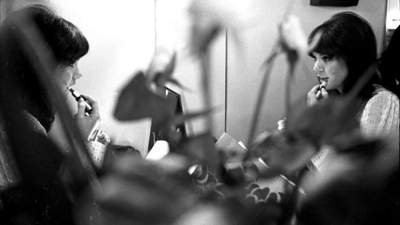


There’s a moment in Linda Ronstadt: The Sound of My Voice when the force of Ronstadt’s star power is nearly overwhelming. Ronstadt is a guest on The Dick Cavett Show, and after delivering a charming interview and gracefully enduring a few condescending remarks from Cavett, she performs a stunning rendition of her 1970 single “Long, Long Time.”
The Sound of My Voice is the latest from directors Rob Epstein and Jeffrey Friedman, who — among other accolades — were nominated for an Academy Award for last year’s documentary short “End Game.” Voice debuted at the Tribeca Film Festival earlier this year, and later secured the Audience Award for Best Documentary at this year’s Provincetown International Film Festival.
The film opens with footage of Johnny Cash introducing Ronstadt on The Johnny Cash Show, saying, “Right now, I’d like you to meet a young lady, a very lovely young lady, that I really think has what it takes to be around for a long, long time to come.” Cash’s introduction is a prescient one, and sets up a montage of highlights from Ronstadt’s career, set to her 1975 No. 1 hit “You’re No Good.”
The pomp and circumstance of the film’s opening gives way to a touching monologue from Ronstadt herself, who narrates the rest of the film. She puts into words why she, still widely considered one of our greatest living vocalists, finds peace in singing, musing on birdsong and the power of music with a clear-eyed passion that shows, despite her current circumstances, singing is still her greatest love.
The first half of The Sound of My Voice is a veritable crash course in Ronstadt’s remarkable career, beginning with her childhood in Tucson, Ariz. The film elucidates Ronstadt’s formative musical influences early on, particularly as they relate to her family. Her grandfather Federico José María Ronstadt in particular is a musical pillar for Ronstadt, as his love of music had a profound effect on later generations.
“There was a lot of music going on in that house,” Ronstadt says of her early childhood in Tucson. “Some of it came in through the radio. That was my best friend in the world.”
As the film explains, one of Ronstadt’s earliest musical endeavors was her band with two of her siblings, The New Union Ramblers, before her brother and sister gave up on music. At the urging of friend and guitarist Bobby Kimmel — who says in the film that Ronstadt’s family band was “one of the best vocal groups [he’d] ever heard” — Ronstadt left Tucson for Los Angeles in 1964. The rest is history.
The film goes on to detail Ronstadt’s stint with The Stone Poneys, their presence at famed Los Angeles venue The Troubadour, L.A.’s then-burgeoning folk movement, the trio’s first record deal with Capitol Records, and Ronstadt’s subsequent move to performing as a solo artist. A romantic relationship with songwriter J.D. Souther proves fruitful when Souther introduces Ronstadt to Glenn Frey, who joins her on the road as a touring guitarist. Ronstadt would significantly raise the profile of Frey and Don Henley’s new band, the Eagles, when she recorded their song “Desperado” on her 1973 album Don’t Cry Now.
Viewers are taken on a chronological tour of Ronstadt’s career, featuring a generous assortment of performance and interview footage, press clippings and conversations with talking heads — notably including Dolly Parton, Bonnie Raitt, Emmylou Harris and numerous other musical luminaries. Her high-profile romances, particularly a relationship with California Gov. Jerry Brown, are reminders that Ronstadt wasn’t just a musical icon, but also a full-fledged celebrity.
Just beneath the surface of The Sound of My Voice is the knowledge that Ronstadt now lives with Parkinson’s disease, which she publicly announced in 2013, two years after announcing her retirement. “That’s what I have now,” Ronstadt says quietly, sharing that her grandmother had the disease too. Later on, the film details her struggles with the disease, and even features a brief moment of singing from present-day Ronstadt, who is quick to say, “It’s a few notes, but it’s not really singing.”
The Sound of My Voice is a must-watch for fans of Ronstadt, as well as lovers of folk music and those fascinated by the iconic Los Angeles music scene of the ’60s and ’70s. It’s not a particularly critical portrait, but it does offer great context for one of our most influential musical figures. More than that, though, it’s a moving look at an artist whose voice has been sorely missed.



