
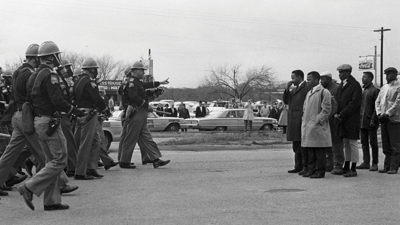


Raoul Peck’s exceptional documentary portrait of James Baldwin isn’t designed to make anyone feel good or encouraged about America or issues of racial and social justice in 2017. Nor is it a cradle-to-grave celebration of the genius and importance of the legendary author, critic and commentator, though it becomes obvious rather early in the film that he is an intellectual and literary giant.
Instead, I Am Not Your Negro is a searing and uncompromising look at this nation’s inability or unwillingness to seriously address the question of the color line. In Baldwin’s view, blacks were not only betrayed, but they’ve never even been fully acknowledged as humans worthy of the same treatment as whites. That same charge could and often was extended beyond racial politics and into issues of class and gender, as well as sexuality. But the main lens that Peck uses here is one of race — and Baldwin never hedged his rhetoric or moderated his views during his brilliant career.
Baldwin saw the struggle as one of good vs. evil, and some of his harshest language is reserved for those espousing actions he deemed timid or overly conciliatory. Peck includes moments of blistering exchanges on such programs as The Dick Cavett Show, wherein Baldwin could be viewed as unnecessarily hostile in a sympathetic climate. But for him, the hurt was too deep, the sins too great and the remedies slow and far too few. Well-meaning rhetoric meant zip to him, as did terms like “militant” and tactical debates regarding the use of nonviolence. It was past time for justice, and that was his only concern.
Peck incorporates contributions from what was to be a major work on Baldwin’s relationships with three civil rights titans — Medgar Evers, Dr. Martin Luther King Jr. and Malcolm X. The volume was supposed to be titled Remember This House, but Baldwin completed only about 30 pages before his death in 1987. Excerpts narrated by Samuel L. Jackson are superbly interlaced into the ongoing piece, as are links to recent events like Ferguson and the emergence of Black Lives Matter.
Baldwin could seamlessly blend the expressiveness of the black church with the linguistic flow of the academy, discuss economics and Westerns with equal aplomb and knowledge, and be at home in Harlem or Paris — it’s a testament to not just his brilliance and numerous experiences, but to the same cosmopolitan sense of being that saw blackness as both universal in appeal and distinctive in reach and presentation.
I Am Not Your Negro is spectacularly bleak, but vividly on point in its depictions of both Baldwin and American racial progress. I suspect if Baldwin were alive today he would sneer at being deemed a public intellectual and profess no surprise at the results of the last election. The challenge he left behind is for the generations still here to truly do something about the injustices and attitudes that enraged him, and which he fought against, his entire life.
Email arts@nashvillescene.com



