
Two new documentaries open at The Belcourt this week, part of its monthlong "Doctober" series. The first, dealing with a contemporary issue, is much more interventionist in tone and quickly establishes good guys and bad guys. The second is a historical excavation, and as such allows hindsight to complicate our understanding of a tragic event.
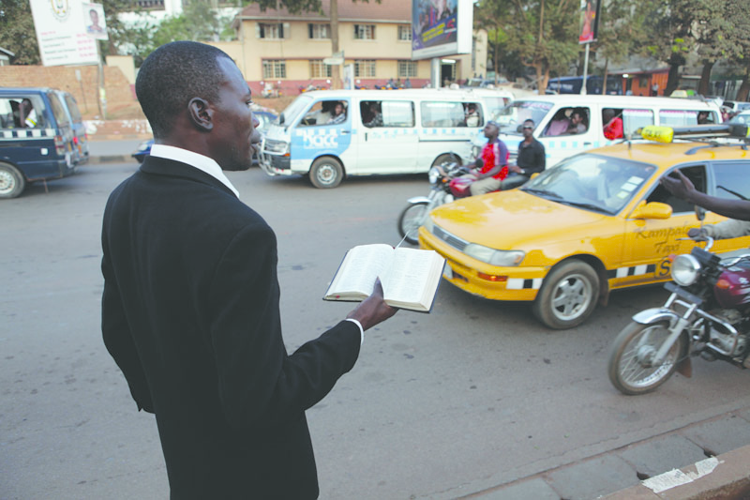
God Loves Uganda is an advocacy doc through and through; unlike so many films that try to disguise their bias, this one has the grace and courtesy to announce it from the get-go. Filmmaker Roger Ross Williams is examining the influence of the Christian right in the East African nation through a well-organized, cash-flush "army" (their word) of missionaries. We can understand the strategy as a church-based variant of Naomi Klein's "shock doctrine." As the Rev. Kapya Kaome, a political researcher, explains from his exile in Boston, the fall of Idi Amin left a power vacuum of poverty and desolation, compounded by the AIDS crisis. Evangelicals like Kansas City's International House of Prayer (IHOP) (no, really) saw this as an opportunity to establish a beachhead for their ideologies in the heart of Africa.
As God Loves Uganda tries to establish, with the help of excommunicated bishop and human rights activist Christopher Senyonjo, American evangelical intervention has led rather directly to a political atmosphere that finds successful AIDS prevention programs replaced with abstinence-only education, and the Ugandan Parliament widely favoring a draconian anti-homosexuality law that would lead to life imprisonment or the death penalty. (IHOP senior member Lou Engel is seen defending the proposed law at a rally in Uganda, although he has since recanted.)
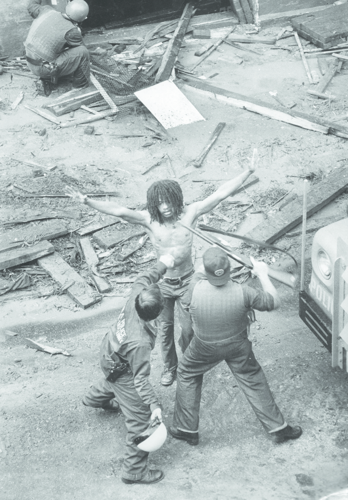
Let the Fire Burn is a film composed entirely of pre-existing footage. There are no talking heads or re-enactments. Filmmaker Jason Osder has gone back to reassemble the contemporary coverage, and the official city council postmortem, of the 1985 police raid on the urban commune MOVE in Philadelphia that led to 11 deaths. A radical black-consciousness group headed by John Africa, MOVE was at odds with police, city officials and the commune's neighbors, many of whom objected to the group's activities, which included blasting obscenities over loudspeakers and piling their yard with rat-attracting compost. The police, for their part, had a chip on their shoulder regarding MOVE, since an earlier raid had resulted in the death of a Philly cop. (MOVE maintained it wasn't responsible.)
Osder's film is structured as a harrowing narrative spiral into inevitability. Mostly organized around the hearing in which city politicians, former MOVE members, the police and fire chiefs and Philly DA Ed Rendell (who would go on to be a pillar of Democratic politics) sought (or shirked) accountability, the film demonstrates certain unavoidable facts. MOVE was a cult, and unlike most cults with their isolated compounds, the group was ensconced in a brownstone in the middle of a city block. This presented unheard-of tactical problems.
Add to this the fact that relations between MOVE and the city had been exacerbated by a racist white mayor (Frank Rizzo), a similarly inclined police force (an officer who saved a little boy from dying in the compound was razzed with vile racial slurs by others on the force), and a new African-American mayor (Wilson Goode) determined to prove that he would stand firm against the "terrorists" of MOVE. In short, the tinderbox was in place. But as Osder's documentary shows, no one in the chain of command ever took responsibility for the decision — and it was a decision — that gives the film its grimly imperative title.
Neither of the two films could be said to be more successful than the other; their aims are markedly different, and both accomplish them in their own fashion. Uganda, which was co-produced by the ITVS for public TV, presents its material in a familiar format. The most surprising thing about God Loves Uganda is the fact that Engel and IHOP fully cooperated with the production. Still, it's undeniably affecting, especially near the end when Williams includes footage from the funeral of Ugandan gay rights activist David Kato (subject of the recent doc Call Me Kuchu).
By contrast, Let the Fire Burn is a more analytical film, one that not only tells a story but also asks its viewers to reflect on how history is documented while in progress. MOVE was anti-technology, and so aside from a few brief films shot by outsiders sympathetic to the group, they were "framed" by the media complex of the dominant culture they struggled so hard to resist. By highlighting this, Osder has made a more difficult film — one that implicitly critiques virtually every other act of contemporary documentation.
Email arts@nashvillescene.com.



