


The tragic, gilded rise and fall of an individual, spelling the coming doom of a culture or way of life. It’s the story told by many folk songs, but it’s also the stuff of genre films. Gangster movies are maybe the best example: The classic antihero is Icarus, who after getting filthy rich through illicit means, flies too close to the sun, surviving only as a warning to others. Like legends you tell to scare children straight, gangster movies exist to remind us that what goes up must always come down.
In the States, gangster movies are often concerned with issues of cultural assimilation — the Godfather films follow the Corleone family’s attempt to become American, and Michael is the resulting fusion of the new country’s managerial spirit and the old country’s sense of fealty. Birds of Passage, the latest collaboration from Colombian filmmakers Cristina Gallego and Ciro Guerra — best known for 2015’s Oscar-nominated Embrace of the Serpent — uses the gangster genre as a method for documenting exchange and encounter, presenting a vivid and living portrait of an indigenous culture. But like most gangster movies, it also comes with a warning.
Though the pan-American drug trade has occupied a significant amount of screen time in recent years — from the Sicario films on the large screen to Narcos on the small — the specific historical era of Birds of Passage has been chronicled less. The period here is the Bonanza Marimbera, usually cited as lasting from 1975 to 1985, in which indigenous peasants in Colombia amassed fortunes trafficking marijuana. The film is specifically focused on the Wayuu, an ethnic group living on the harsh Guajira Peninsula, which straddles the border of Colombia and Venezuela.
Our protagonist, Rapayet, wishes to marry Zaida, the daughter of the formidable matriarch Úrsula. After learning that the necessary dowry is well beyond what he makes hauling coffee beans, Rapayet begins selling pot to American Peace Corps volunteers who are “combating communism” in the region one toke at a time. Rapayet and his partner Moses attract the attention of larger American suppliers, and the business soon becomes much more than a one-time deal to pay for a wedding. But more addictive than marijuana is capitalismo — it takes only one whiff of green to get hooked.
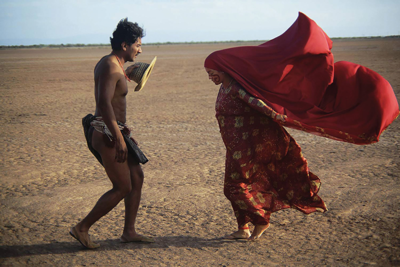
Though Birds of Passage takes place over a period of 20 years, Gellago and Guerra make sweeping historical change feel intimate. Their film’s visual schema is supplied by the various cultural conflicts at hand: The colorful robes worn by Wayuu women contrast with not only the stark aridity of their native landscape but also the forbidding modernism of Rapayet’s drug-money mansion, which is, to quote rapper Rich Homie Quan, painted “all-white, DMX like in Belly.”
Birds of Passage is intriguing because of its denial of the genre’s most salient tropes. We hardly ever see the drug itself or consumption thereof; there are no Giorgio Moroder-scored montages of cash machines and Armani suits. Familiar resonances are felt, but the lurid details that so many gangster films linger on are absent or almost invisible. Instead the focus is on the Wayuu and the various rituals and practices that have coalesced into their culture. The Wayuu are strictly governed by tradition, which informs how they do business. Their world is divided in two: the Wayuu themselves, and the “alijuna,” a word roughly translating to “the ones who damage,” meaning anyone who is non-Wayuu. When an alijuna comrade kills an American business associate, Rapayet tells him to clean up the mess himself, because the Wayuu are forbidden to touch murdered bodies — numerous other rules dictate how Wayuu clans live and communicate with one another. The Wayuu and the archetypal gangster may have different ways and means, but they are united in their adherence to rigid codes.
The Wayuu share narrative through song, and Gellago and Guerra weave that indigenous storytelling form into the structure of their film. It’s split into five chapters, called “cantos” by title cards — each is another verse in a bloody murder ballad. The film ends with a song warning of what happens when tradition is forsaken. In the ashes of empire, all that’s left is a child, abandoned by the parents who put prosperity first. In the space of a single generation, the knowledge needed to tame and tend the land has been lost, and the child is left to wander the earth without the assistance of her ancestors’ knowledge. There’s no history now, no culture to repeat, only dirt.
It leaves us to consider how much desert our own empire has created, and how few of us know how to make a life in that kind of landscape. Through its preservation and repetition of indigenous practice, Birds of Passage takes a stand against the unmindfulness that leads to cultural deserts.



