

With Nightmare Alley, Oscar winner and highbrow genre director Guillermo del Toro has finally made the film noir of his dreams. He teamed up with film critic/noir historian Kim Morgan to adapt William Lindsay Gresham’s 1946 novel of the same name, which became a skeevy-ass bit of postwar pulp when British filmmaker Edmund Goulding (Grand Hotel) brought it to the big screen the following year. The ’47 version featured swashbuckler Tyrone Power in the lead role, a con man who picks up some things while working at a carnival and pushes his luck when he uses them to become a successful, swindling medium.
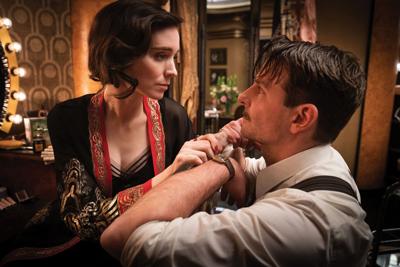
Producer Bradley Cooper assumes the con-man role of Stanton Carlisle, a mysterious drifter who gets wrapped up in the carny life, learning the tricks of the trade from an impressive lineup of actors (Willem Dafoe, Toni Collette, David Strathairn, Ron Perlman) who cynically entertain and hoodwink folks. Carlisle falls in love with electricity-absorbing performer Molly Cahill (Rooney Mara), who becomes his assistant when they leave to make it as a big-city nightclub act. Things get dirty and dangerous when Cooper’s faux psychic falls in league with a psychiatrist (Cate Blanchett, once again working that crazy white-girl magic of hers) who feeds him info on grieving patients willing to pay top dollar to communicate with their deceased loved ones.
As twisted and trashy as this sounds (Goulding’s 1947 version indeed fully embraced that energy), del Toro — as he always does — concentrates more on turning this into a visually ambitious morality tale. He brings along previous collaborators — cinematographer Dan Laustsen, production designer Tamara Deverell, set decorator Shane Vieau — and allows Cooper’s drifter to dip into a curious, intriguing carnival world in the first half. In Nightmare’s back half, Carlisle is morally adrift in his snowy, swanky, Art Deco’d-to-hell surroundings.
The story itself is a bit obvious, as Carlisle’s greed-fueled manipulative skills inevitably lead to serious consequences. The performances also show that del Toro isn’t the only one indulging in noirish theatrics — Blanchett goes so full-tilt with her cunning scenery-chewing, almost like she’s delivering some histrionic performance art. Nevertheless, del Toro uses all of this to create sequences in which we can marvel at all the sophisticated splendor, both visually and formally. There’s one scene where Cooper chases Mara through the men’s bathroom of a bus station — as del Toro’s camera chases the both of them — that’s such an elaborate sight, you’d swear ol’ boy is just showing off at this point.
In true del Toro fashion, Nightmare Alley is yet another film in which morally bankrupt folks who play God end up paying the price. It may not have the sort of freakish monsters del Toro has previously brought to the big screen, but it does continue the tradition of stories where the real monsters turn out to be the human ones.



