
New parents often slip into what could be called "the despair phase," after the novelty of having a baby wears off and the child starts sleeping less and crying more. The despair phase typically doesn't last very long — it usually ends around the time the baby starts smiling and laughing — but those same feelings of hopelessness start to creep back in with "the terrible twos" and the often worse "terrible threes," when children get bigger, stronger and more willful, and are less persuaded by the threat of punishment. At times, living with a 3-year-old is like living with an angry alcoholic, spending every waking minute tiptoeing around the inevitable explosion.
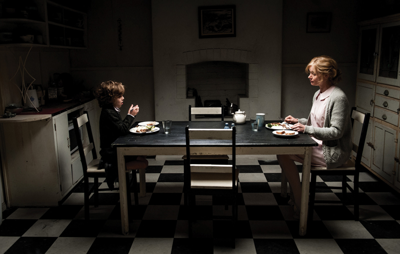
In The Babadook, Essie Davis plays Amelia, a young widow who gave birth to her son Samuel (Noah Wiseman) on the night her husband was killed in a car accident. Now 6 years old, Sam is, to put it politely, "a problem child." His obsession with monsters — and with constructing monster-fighting weapons — gets him kicked out of school. His quick temper and hyperactive monologues cost Amelia her remaining adult friends, while interfering with her job at a local hospital and keeping her awake at night.
One day, while still loopy from lack of sleep, mother and son crawl into bed and read a strange pop-up book that Sam found: the story of a creature called The Babadook, who finds hospitable households and moves in permanently, knocking on walls and frightening the inhabitants until they slip into a murderous rage. ("You can't get rid of The Babadook," the book cheerfully warns.) After Amelia and Sam read Mister Babadook, everything in the book starts coming true. Even when Amelia tries to destroy it, Mister Babadook keeps coming back.
Most horror movies follow a comfortingly predictable rhythm: After one big early scare, they settle into a pattern of build-up and payoff, increasing in frequency up to the closing credits. The Babadook writer-director Jennifer Kent disrupts that rhythm. The movie starts with some mild haunted-house creepiness, then about a third of the way through begins pummeling the characters (and the viewer) so ferociously that it's hard to imagine how the film could get any scarier. But it does. Oh, it does.
What's most terrifying about The Babadook is that Kent grounds a bizarre supernatural premise in very real feelings of anxiety and depression. Davis gives a heartbreaking performance as a woman who feels desperately alone, burdened with a child who's hard to love. (Wiseman is believably aggravating, too — not an easy beat for a young actor to play.) Though it's a low-budget film that takes place mostly inside one house, The Babadook has impressive effects, using unsettling makeup, looming shadows, quick cuts and the guttural croak of "baaa baaa dook dook dooooook" to keep the audience unmoored. Kent's best effects are her actors, who are so convincingly haggard that every move they make against the monster looks all the more heroic.
That's what makes The Babadook so haunting, and so satisfying not just as a horror film but as a human drama. Kent very plainly means The Babadook itself as a metaphor for Amelia's grief, and for her fear that Sam's behavioral issues are going to be a lifelong burden — for him and for her. That's her real bogeyman, and it's one that should be relatable to anyone who's ever tried to quiet a screaming child in a supermarket, or been awakened at 2 a.m. by a tantrum for the fifth night in a row. The nightmare just keeps recurring for Amelia. Even when the sun rises and the ghost disappears into the shadows, she still has to deal with her grief, her alienation, her lousy job and her frustrating son. Kent uses classical horror techniques to jolt the audience throughout The Babadook, but she also plagues the subconscious — asking us what exactly we're supposed to do with all of these everyday monsters that we can't get rid of.
Email arts@nashvillescene.com



