
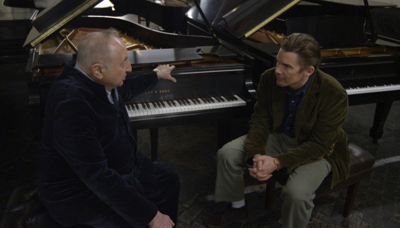


Imagine if Kurt Cobain had decided to live off the grid after making In Utero instead of staying on the treadmill of music industry “success” that ultimately contributed to his suicide. Even if he had kept shooting heroin, he probably would’ve lived longer and been happier. Seymour Bernstein, the classical pianist at the center of Seymour: An Introduction, Ethan Hawke’s documentary debut, quit performing in public at the age of 50. More than 30 years later, he has no regrets.
Granted, classical musicians aren’t treated like rock stars in American culture. Plus Bernstein had a way out: He became a piano teacher instead. Nevertheless, America has a way of forcing everyone to become materialistic just to survive. Bernstein seems to have found a path out of this trap, finding joy and satisfaction that have nothing to do with a need to see his name in lights. Throughout the film, Hawke drops clues that’s the reason he made this portrait of the pianist.
Seymour: An Introduction isn’t formally groundbreaking, but it does stray away from the interview/archival footage formula followed by so many documentaries. To be clear, Hawke does use archival footage, but none of it depicts the younger Bernstein or simply illustrates his points. Only pianists like Glenn Gould — cited by Bernstein as a negative example — and Clifford Curzon are shown, in relatively short clips, as well as a wide variety of other musicians and their audiences.
Hawke’s film relies heavily on Bernstein talking, both in interviews and less formal settings. Hawke himself talks with Bernstein, but New York Times writer Michael Kimmelman also interviews the pianist in a restaurant. Additionally, Bernstein speaks about music and spirituality with author Andrew Harvey.
Hawke isn’t exactly Tom Cruise; in the long run, he’s going to be remembered for his collaborations with Richard Linklater, which rival Robert De Niro’s streak with Martin Scorsese or Jean-Pierre Leaud’s run with François Truffaut. All the same, he speaks about the emptiness of a life devoted to chasing money and fame. One gets the sense that he made this film to answer certain questions about what happens after an actor has achieved these worldly goals. Bernstein proudly says that he lives like a monk, in a comfortable but small one-bedroom apartment. Hawke obviously hasn’t given away his money, but he’s used it to get relatively uncommercial projects like Seymour: An Introduction made.
Bernstein’s idealism recalls an unlikely partner in faith: Alejandro Jodorowsky. Indeed, Seymour: An Introduction is the best documentary about an artist I’ve seen since Jodorowsky’s Dune. (Thankfully, Bernstein doesn’t share Jodorowsky’s cavalier machismo.) Both men speak about the transformative possibilities of music and film, respectively, in ways that are deeply unfashionable now. Bernstein rejects organized religion in favor of the notion of a “God within” — for him, salvation lies in individual reach, not in someone else’s judgment.
Seymour: An Introduction shows a few signs of Hawke’s lack of directorial experience. Its structure feels a bit awkward. While Bernstein talks about his days in the Army during the Korean War (where he and fellow soldier/musicians played to enthusiastic audiences of grunts), he’s mum about most of his personal life. But there’s a refreshing modesty and humility to the film.
Damien Chazelle’s Whiplash earned critical kudos and won three Oscars by arguing that music teachers ought to scare the crap out of their students in order to get the best from them. Bernstein’s gentle but firm presence — shown in a great deal of footage with students, where he suggests that they use the piano’s soft pedal — argues in favor of embracing one’s feminine side, not bringing out the inner beast. Academy Award or not, Hawke and Bernstein make a better case than Chazelle and J.K. Simmons.



