
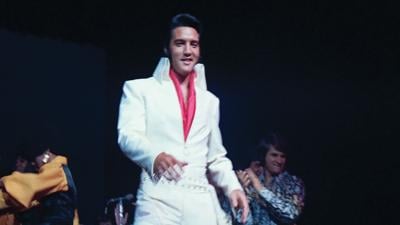


Elvis Presley in EPiC
EPiC: Elvis Presley in Concert — the new “cinematic experience” from director Baz Luhrmann, opening wide this Friday — is not exactly a concert documentary. It pulls from previously lost footage of the musician’s late-career Vegas residency and 1970s tours, but it begins, like a trailer for itself, with a lengthy montage of the familiar beats that led up to it: Elvis’ childhood, his rise to fame, his shaking hips. When he gets arrested, huge letters appear on the screen: “ELVIS ARRESTED.” When he gets drafted, we see “DRAFTED.” Later, when his movie career begins, we see the word “HOLLYWOOD,” which promptly explodes.
Luhrmann is very interested in Elvis. It’s a perfect match: Luhrmann is known for baroque films about vainglorious characters, and the popular mythology of Elvis is about as baroque as you can get. Particularly his Vegas period, which EPiC ostensibly focuses on, and which Luhrmann’s 2022 biopic Elvis cast as a deal with the devil. In that movie, as Austin Butler performs “Suspicious Minds” and the score grows tense, a hotel bigwig scrawls contract terms on a cocktail table with Tom Hanks’ Col. Tom Parker, the singer’s controversial manager and Elvis’ villain. “Elvis Presley at the International Hotel for 5 years,” the writing reads. “All previous debts canceled.”

Luhrmann’s outsized Presley biopic opens wide this week
Years ago, when I left the theater after watching Elvis, I couldn’t stop laughing. I was baffled by the fact that I had spent $15 and three hours to watch Hanks butcher a Dutch accent in prosthetics when I’d thought I was going to mostly see … well, Elvis. After EPiC, I felt a newfound sense of clarity. It’s funny that Luhrmann would use the same shtick in his second Elvis movie — spelling out so literally exactly what’s going on — but it’s also telling.
Telling, because between all the rhinestones and exploding typeface, EPiC helped me put into words what it is I reject so much about Baz Luhrmann’s vision of Elvis: He never lets the audience draw their own conclusions. EPiC is framed by a recording of an Elvis quote: “There’s been a lot written and a lot said, but never my side of the story.” But Luhrmann seems less interested in using the footage he’s compiled to discern Elvis’ “side of the story” than he is in lending authenticity to his own previously trod narrative about the singer — and then spoon-feeding it to us all over again.
EPiC is the most on-the-nose when it circles back to Col. Tom Parker. In the biopic, when he has a heart attack, Parker is shown floating through spacetime and reflecting on his sins: exhausting Elvis, pushing him deeper into addiction, taking his money and preventing him from ever touring outside the U.S. In the documentary, he’s introduced by an echoing sample of his name, which plays over a film clip of Elvis with a gun pointed at his neck. In a confused, ham-fisted statement, Parker is also implicated in muzzling the singer’s political opinions while the song “In the Ghetto” plays. I had to wonder: Is there any room left to actually confront the man behind all this menace? What great political stance does Luhrmann think Elvis would have offered, if Parker was single-handedly preventing him from speaking out? And is Elvis himself in the way — should Luhrmann just be making movies about Col. Tom Parker?
There are truly fascinating moments in EPiC. I was especially intrigued by clips of Elvis being playful in his Vegas rehearsal space and chipper during a period that’s largely portrayed as a downward spiral. There’s a surreal sequence — reminiscent of 2022’s Norwegian film Good Boy — from the film Live a Little, Love a Little in which he talks to a man in a Great Dane costume. The trove of concert footage that Luhrmann has uncovered and restored is undoubtedly a goldmine for Elvis fans.
But toward the end, as Elvis repeats the “Suspicious Minds” line “caught in a trap” like he’s stuck in some giddy hell, I mostly felt like EPiC was another missed opportunity. There are few artists so mythical, so entwined with the United States’ history and conscience as Elvis — so primed, in fact, for a great layer-peeling music documentary like Gimme Shelter or Let’s Get Lost. It’s too bad Luhrmann can’t let the story breathe.



