
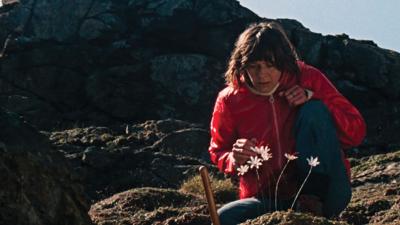

If it weren’t for that 2022 copyright date, it’s entirely possible you’d take Mark Jenkin’s folk-horror freakout Enys Men (pronounced EH-nez MANE) as a lost treasure from 1973 that somehow resisted the ceaseless searching of modern horror audiences. Of course, the unspoken irony is that in the field of horror, and especially folk horror, finding that which was hidden can often unleash whole other predicaments. Thankfully, this isn’t one of those films that curses you just by watching it (as best I can tell), but it does cast a very specific spell that draws you closer, even as shock and terror reveal themselves with the patience and deliberate pace of a screwed-and-chopped burlesque.
Enys Men isn’t about a curse reaching beyond its genesis, or even really beyond itself. The title means “Stone Island” in Cornish, and it’s a remarkable location, easily earning its titular status. It is picturesque, filled with a varied collection of biomes and landscapes and just a little bit out of sync with time; that’s part of why The Volunteer (Mary Woodvine) is there, the only sentient living being on the island, investigating anomalies in the flora. But it isn’t just those striking flowers that throw certainties into imbalance, because it seems everything that has happened on Enys Men is to some extent still happening. That line between Now and Then that we use to differentiate memory from experience? It’s not there. There is only Now, and there is more on this island than any one person could ever expect to bear.
Writer-director Jenkin knows exactly what he’s doing here. He’s seen the legendary films of folk horror and understands what works and what doesn’t, and he’s pared down the narratives mercilessly, avoiding exposition and any authoritative voice beyond the film’s cuts. There are ghosts, and phantom maidens, and doomed sailors, and around it all a sense of teleological inevitability. Though set in 1973, the sense of fixed entropy feels unsettlingly relevant to modern viewers, and Woodvine does an impeccable job of bringing several different emotional vectors to life in a remarkable, nearly wordless performance.
If Skinamarink was just a bit too abstract and The Outwaters was a tad too shaky or gory for you, this may be the avant-garde found-footage film that connects with wherever you keep your fears locked away.



