
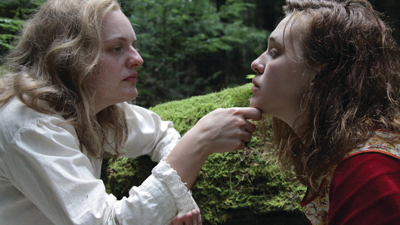


I’m thoroughly convinced that Elisabeth Moss is the queen of patriarchal pain. Judging from the roles she’s played on prestige TV shows Mad Men, The Handmaid’s Tale and Jane Campion’s Top of the Lake and in movies like The Invisible Man (one of the last blockbuster multiplex hits before the pandemic shut all that shit down), it appears Moss’ mission is to show the figurative (and sometimes literal) stranglehold men have had on women throughout history. No matter what she’s in, there is a strong possibility that at some point she’ll be crying, miserable and utterly fed the fuck up by all the abuse she’s had to take from men.
All three of those things happen in her latest film, Shirley, which made the Sundance Film Festival rounds earlier this year, where it won the U.S. Dramatic Special Jury Award for Auteur Filmmaking. In the film, which is available to stream via the Belcourt’s site this weekend, Moss plays a real-life figure: horror author Shirley Jackson, the woman behind The Haunting of Hill House and other creepy, sinister pulp. The whole thing is set in the 1950s, with Jackson living in Vermont with her husband, critic and professor Stanley Edgar Hyman (Michael Stuhlbarg), who teaches at Bennington College.
They both welcome two new people in their abode: Fred Nemser (Logan Lerman) and his wife Rose (Odessa Young), who has been known to get hot-and-bothered by Jackson’s prose. While Fred joins Stanley in teaching the young women of Bennington about folklore and Shakespeare and what not, Rose stays at the house, cleaning up and basically babysitting the introverted and unpredictable Jackson. Rose soon becomes Jackson’s partner in crime, getting documents for her and practically serving as her assistant as Jackson works on a new novel, based on the disappearance of a real Bennington coed — a project that would ultimately become her 1951 novel Hangsaman.
I hate to say this movie reminds me of a certain unnamed Edward Albee play (later adapted into a film starring Richard Burton and Elizabeth Taylor) in which an older couple puts a younger couple through so much drama — especially since so many people said so when Shirley played Sundance. But, yeah, it does. Moss and Stuhlbarg are the world-weary marrieds who wrap Lerman and Young’s newlyweds in their twisted, passive-aggressive web of whatever-the-fuck. As Stuhlbarg’s pedantic professor shows Lerman’s willing pupil the perks of teaching female students, it’s hinted that Moss’ Jackson may have gotten her Portrait of a Lady on Fire on and seduced Young’s pregnant stay-at-home wife.
I should tell you that none of this shit really happened — the whole thing is based on Susan Scarf Merrell’s 2014 what-if novel, also named Shirley. But this movie is really a chance for Madeline’s Madeline director Josephine Decker to once again craft a story centering on a brilliant, creative and undoubtedly disturbed woman. Working from a script by Sarah Gubbins, Decker — ever the experimental filmmaker — curlicues around the action, as she and cinematographer Sturla Brandth Grøvlen film everything like a Gothic dream bathed in kitschy, sepia tones. This also makes the central characters look like they’re mired in the sticky, complicated past — it’s like they’re drowning in molasses.
Decker definitely found a sister-in-arms in Moss, who has never had a problem playing complicated, sometimes insufferable artists. (See practically everything Moss has done with director Alex Ross Perry for further reference.) Shirley is really another chance for Moss to sink her teeth into a role with the same snarling, fuck-the-patriarchy gusto she’s brought to nearly everything she’s done. As Jackson, Moss once again plays a character who seeks to create her own destiny and implores other women around her to do the same — including all the women in the audience.



