
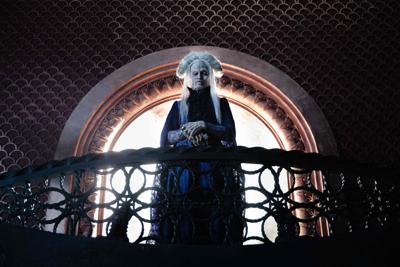

Romance is trending at the movies — but I’m not talking about cuddly couples’ comedies. Romantic movements in Western art and literature (approximately 1790 to 1850) forwarded values that favored nature over industry, emotional passion above reason and the experience of the awesome and the sublime beyond the reach of religious institutions. Romance with a capital R is back in a big way, and the trend is most obvious on our cinema screens, where titles like Frankenstein and the forthcoming The Bride, Wuthering Heights and Werwulf all connect to the period and/or its aesthetic. The horror films in this lot all lean into the darker gothic side of Romanticism, and Luc Besson’s new Dracula may turn out to be one of the best of the bunch.
Writer-director Besson (The Fifth Element, Léon: The Professional) reimagines Bram Stoker’s classic vampire tale as a gothic romance. When 15th-century Prince Vladimir of Wallachia (Caleb Landry Jones) witnesses the brutal murder of his wife Elisabeta (Zoë Bleu) during battle with the Ottomans, he renounces God and damns heaven itself. Cursed with eternal life, he is reborn as Dracula, an immortal who defies fate in a crimson crusade to reunite with his one true love.
Over four centuries, Dracula searches for Elisabeta’s reincarnation — deploying vampire agents to assist in his quest and developing a perfume no woman can resist. His search leads him to negotiations with Parisian solicitor Jonathan Harker (Ewens Abid), where Dracula discovers that Harker’s fiancée Mina may be the reincarnation he seeks. All the while, a relentless priest (Christoph Waltz) hunts Dracula, sworn to end his immortal reign. Danny Elfman composed the score.
This lovelorn plotline isn’t part of Stoker’s book, which is more about real estate deals and Victorian sexual anxieties, and is revealed in a series of letters. It’s more correct to think of Besson’s movie as a remake of Francis Ford Coppola’s 1992 film Bram Stoker’s Dracula. Coppola’s film includes a rather convoluted script and uneven performances: Gary Oldman is ferocious in the title role, while Gen-X darlings Keanu Reeves and Winona Ryder struggle to find their footing in a period piece. Even so, Coppola’s costumes, production, practical effects and nods to early horror cinema have made the movie a cult classic.
Jones is a demonic delight as Besson’s king of the bloodsuckers, and he sometimes resembles Klaus Kinski, conjuring visions of Werner Herzog’s 1979 remake of F.W. Murnau’s vampire classic Nosferatu. Besson’s script is clearer than James V. Hart’s script for Coppola’s film, and the supporting cast — especially Waltz — is consistently believable despite the supernatural goings-on. Colin Wandersman’s cinematography makes this glam-goth romance a brooding dance in shadow and light. Besson brings his flair for action to Dracula in bloody battles with lots of slashing swordplay, and his costumes and interiors are sumptuous and stylized — even if some of the digital effects are as jarring as Coppola’s practical illusions are magical.
Besson’s Dracula is thoroughly entertaining. It offers a fresh take on the undead aristocrat that balances period eye candy with bloody thrills. Its combination of elaborate costumes, action, gallows humor and horror makes this the Valentine’s Day date movie everyone can sink their teeth into.



Post a comment as anonymous
Report
Watch this discussion.
(0) comments
Welcome to the discussion.
Log In
Welcome to the discussion.
Keep it clean. Please avoid obscene, vulgar, lewd, racist or otherwise abusive language. Comments featuring hate speech or threatening or violent content will not be tolerated.
PLEASE TURN OFF YOUR CAPS LOCK.
Be truthful. Don't knowingly lie or mislead.
Be proactive. Use the “report” link on any comment that violates our comment policy.
Share with us. We'd love to hear your feedback.