
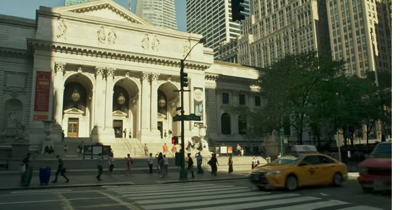


While the institution it examines is wonderfully, proudly for everyone, the documentary Ex Libris — The New York Public Library most certainly isn't.
The 43rd film from 87-year-old award-winning documentarian Frederick Wiseman clocks in at three hours and 17 minutes. As is Wiseman's way, there is no narration or soundtrack. The film's score, if you will, is made up of the occasional siren from a fire truck, the echoing conversations in the library's great halls or the stacking of books by dutiful staffers. The filmmaker's presence, or that of his camera, is never acknowledged. Not a single person in the film looks our way, and no one is even identified.
Still, through Wiseman's careful editing, a story emerges. The film turns out to be a strolling tour of New York's library system and the many manifestations of its mission to serve New York's citizens. Through the camera, we pop in and out of various offices, meeting rooms and lecture halls. A book event with Elvis Costello or Ta-Nehisi Coates; a job fair; a lecture on the history of theological debates about slavery within Islam; a meeting in which library leaders discuss how to find the right balance between their digital and physical catalogues; and a community discussion of racist falsehoods published in school textbooks.
If Wiseman's style as a filmmaker doesn't satisfy one's tastes, his film nevertheless leaves one in awe of an institution such as the New York Public Library and its counterparts in cities around the world. From the heroically helpful librarians seen assisting patrons of all races, genders and ages to the stunning architecture of the building itself, the many facets of the place are the stars of Ex Libris. And without so much as a word of voice-over or a single title card or caption, Wiseman highlights certain crucial themes by returning to them again and again throughout the film: Chief among them is the importance of libraries (among other public institutions) when it comes to bridging the growing digital and technological divide in our society, and their vitality as a place where the truths about our history are preserved and openly discussed.
Could the film be shorter? Yes. It takes some effort to get through, and undoubtedly, there will be scenes during which certain viewers find themselves checking their watches. Still, in Ex Libris Wiseman has made a film that is similar to the experience of going to a cavernous old library, where quiet rooms and seemingly endless rows of shelves can appear dull until one stops to focus in on one book, exhibit or lecture, and becomes mesmerized.



