
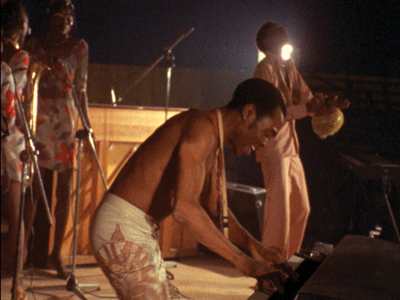

Nigerian musician Fela Kuti invented a whole new style to express himself: Afrobeat, a thrilling combination of funk, jazz and indigenous African forms. Alex Gibney's documentary Finding Fela would be better if it matched the innovative energy of its subject, but isn't up to the task.
Most of Gibney's films are works of investigative journalism, and the influence of Errol Morris' The Thin Blue Line hovers over them. Even if Gibney has never hit the poetic heights of Morris films like Fast, Cheap and Out of Control, he's more politically astute than his role model. Nevertheless, the investigation into Kuti's life is already complete — the man died in 1997 — and that leaves Finding Fela with little to do but cannibalize the 1982 documentary Music Is the Weapon and the Broadway play Fela! for much of its footage, since it can't draw on new scenes of Kuti speaking or performing.
Finding Fela's reliance on Fela! is both its biggest strength and its most telling weakness. Gibney has a gift at his disposal that most directors of documentaries about dead musicians never get: an archive of expositional B-roll. This means he can illustrate an anecdote about Kuti's life with a scene from the play, or supplement archival performance footage of with music by the Fela! cast. After all, Gibney didn't start this project himself. The backers of Fela! began documenting its pre-production themselves, and they brought Gibney onboard to film a performance in Lagos, Nigeria.
Kuti played dense labyrinthine grooves, with complex structures that gradually rise and fall. Finding Fela makes the case that Kuti's best music was made in the '80s, with his second band Egypt 80, when his songs expanded almost to the half-hour mark. Gibney's favorite Kuti song, the anti-apartheid anthem "Beasts of No Nation," runs for 28 minutes and fills an entire album. As a commercial for Kuti's music, Finding Fela is certainly effective; since seeing it, I've bought two of his albums, including Beasts of No Nation.
Kuti also sang explicitly about the corruption of '70s Nigeria, a style of activism that culminated in the anti-military song "Zombie," which became his biggest hit despite getting banned from the radio. This resulted in a raid on the commune where he lived in polygamous marriage with 27 wives. His mother died after being thrown out a second-floor window. Rather than backing down, Kuti addressed the incident on his next album, Coffin for Head of State. Finding Fela illustrates these matters with copious footage from the play and, to a lesser extent, present-day interviews with Kuti's family, musicians and musicologist Michael Veal. There is also plenty of extraneous footage of theater director Bill T. Jones and the actors sitting around talking, which adds nothing.
Ultimately, Finding Fela loses its narrative backbone when it can no longer rely on gifted footage and must focus on the actual man. While the Afrocentrism of '70s-era Kuti was triumphant and genuinely righteous, he fell under the spell of a bogus guru in the '80s as the government continued to arrest and harass him. He eventually contracted HIV, a disease whose existence he doubted, and continued having unprotected sex with multiple women after his diagnosis. One of the last songs he wrote condemned condoms as un-African. In other words, Kuti didn't exactly go out on a high note, so it's no wonder Gibney concentrates on the '70s, which were arguably Kuti's cultural zenith. Unfortunately, this film never reaches such heights. At its best, Finding Fela replicates the energy of songs like "Zombie." At its worst, it feels more like watching an actual zombie — and too staid to do justice to such a radical figure.
Email arts@nashvillescene.com.



