
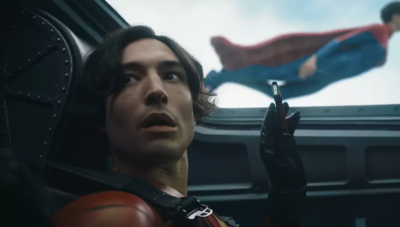

When The Flash is nimble and firing on all cylinders, it’s a wonder to behold. An opening hospital set piece involving the rescue of a fusillade of raining babies one-ups the Quicksilver run-throughs of the next-to-last two X-Men films with a leavening injection of Tex Avery/Hellzapoppin’ mayhem. It’s silly and joyful. And the film finishes just as strongly, with a couple of great comic reveals and unexpected cameos that amp up one’s sense of old-school comic book jollies. Director Andy Muschietti (It) and writers Christina Hodson and Joby Harold aim for quippy and brisk (a tattoo reveal being one of the comedic flourishes of the year), and they keep things going along well, even if the big reality-jumping center section of the film drags at times.
In the vastly superior Snyder Cut of Justice League, we learned that Barry Allen — the titular Flash — could engage with what’s known as the Speed Force and do an instant replay of things. This film takes that further — to the extent that he can go back in time and avert the tragic murder of his mother. Naturally, because this is a comic book movie, he does. But then he finds himself in a world without Superman, Wonder Woman or Aquaman. Also Batman is now different, triumphantly played by Michael Keaton once again after 30 years. And then Michael Shannon’s Kryptonian space eugenicist General Zod shows up (with nothing to do, sadly also true of Sasha Calle’s Supergirl), and there’s a big battle (but no “Batdance”) and tragic lessons to be learned.
Given that seemingly every piece of media is unleashing its perception of whatever the multiverse may be, it’s refreshing that The Flash treats it as more of an existential test — an exercise by which one must learn about themselves rather than picking and choosing moments to cultivate specific outcomes. It also makes the very interesting choice of keeping the theoretical, or potential, alternate things the characters encounter in divergent timelines as not-quite-there CG models, which allows for a consistent delineation between The Real and The Possible.
As for the big elephant in the room, it’s impossible to divorce the presence of repeatedly accused criminal mastermind Ezra Miller from this film. What’s honestly staggering is that were it not for all those pending criminal cases, Hollywood would be rolling out the red carpet for the actor, because Miller gives two more-than-good and differentiated performances as the Barries Allen. It’s not an exaggeration to put them on par with Jeremy Irons and Rachel Weisz in both Dead Ringers incarnations, or Tatiana Maslany’s unparalleled Orphan Black triumph. But it’s impossible to fully get past. Ever since seeing Afterschool back in 2008, there was always the thought “I hope this kid is gonna be OK.” And there’s nothing I can say as a critic to stop anyone from seeing the film who wanted to, just as there’s nothing I can say to compel anyone to see it who wasn’t going to do so because of Miller anyway. There’s a certain irony about the immutability of fate being the thematic thrust of a generally delightful film that may well be the pinnacle of a promising career with nowhere to go.



Post a comment as anonymous
Report
Watch this discussion.
(0) comments
Welcome to the discussion.
Log In
Welcome to the discussion.
Keep it clean. Please avoid obscene, vulgar, lewd, racist or otherwise abusive language. Comments featuring hate speech or threatening or violent content will not be tolerated.
PLEASE TURN OFF YOUR CAPS LOCK.
Be truthful. Don't knowingly lie or mislead.
Be proactive. Use the “report” link on any comment that violates our comment policy.
Share with us. We'd love to hear your feedback.