


And here we thought we had Damien Chazelle figured out.
The young filmmaker — the youngest ever to win the Best Director Oscar, which he did with 2016’s La La Land — makes films about jazz. Whether it’s his 2009 debut Guy and Madeline on a Park Bench or 2014’s acclaimed Whiplash, Chazelle’s films are about characters who make music, specifically jazz, and his stories are often told musically, both literally and metaphorically.
It stands to reason that the director’s fourth film would take a stylistic turn to some degree. Anyone so talented — and make no mistake, Chazelle is talented when it comes to both crafting narratives and executing them beautifully — would surely want to challenge himself at some point. But via a Neil Armstrong biopic, loaded with technical detail? It’s a hard left turn.
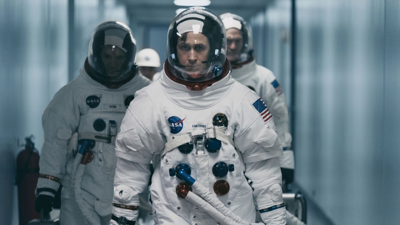
Chazelle’s First Man is packed with moments of high tension inside the cockpits of massive spacecraft, which rumble and groan under their own weight as the camera remains fixed on the dispassionate faces of astronauts. Those moments are interspersed with the occasional Malick-esque sequences of mid-’60s domestic life, all of them gorgeously shot. Ryan Gosling tamps down the star power we saw in La La Land to play the even-keeled Armstrong, a reluctant hero who famously ducked the spotlight throughout his life. He was a brainy Ohio native, a pilot with the Right Stuff, and here Gosling simply delivers an impossibly handsome version of that. The death of Armstrong’s young daughter Karen in 1962 serves as the emotional engine of the film. A movie about remarkable human achievements would be nothing without actual humans, after all, and even though Claire Foy gives what is perhaps the film’s strongest performance as Armstrong’s wife Janet, Gosling’s stoic anguish gives us non-heroes something to latch onto.
But the conflict at the center of First Man is man vs. physics, man vs. fate, man vs. seemingly insurmountable odds. Thus, interpersonal conflict isn’t near the top of the agenda. There is a touch of that between Armstrong and his fellow astronaut Buzz Aldrin, played with perfect shades of tactlessness by the ever-solid Corey Stoll. Buzz is showier, louder, somewhat uncouth, and that rubs against the grain of Armstrong’s distinguished stoicism. But those moments are somewhat few and far between, as our astronauts are all truly pulling in the same direction.
Ultimately, like the Apollo 11 mission itself, this is a film that could be executed only one way to be a success: with great technical skill, as close as humanly possible to perfection. Anything less would be tantamount to failure, and Damien Chazelle doesn’t fail.



