
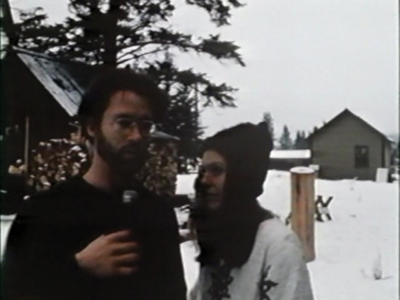
A figure like Jon Jost probably won't come along again anytime soon. Whether this is a good or bad thing for independent cinema in the U.S. is, quite frankly, an open question. What would the Sundance and Weinstein universe do with someone who has so little use for money, authority or the polite bourgeois pieties that grease the contemporary film industry? Here's a man who would rather walk away from the material trappings of success, so vitally important to so many, in order to make the work he wants to make. Jost works small, so that he can work true.
And yet he is no romantic Luddite. Everyone adapts. If you go to the website of Jon Jost, one of the most fiercely independent filmmakers the U.S. has ever produced, you will find statements on the virtue of digital imaging tools, along with information about renting or purchasing his films and videos from him directly. This includes recent works, made specifically in and for the DV medium, and Jost's older films, which were shot and edited in either 16mm or 35mm film. While many artists quite understandably lament the inevitable loss of celluloid as a means of aesthetic communication, Jost isn't looking back, except to get those early works out into the world. One of those works, his 1973 film Speaking Directly, screens at Third Man Records 7 p.m. Thursday as part of The Light and Sound Machine series.
Much of the so-called independent cinema of today wouldn't really be possible without Jost, who spent the 1970s making poetic experimental narratives like Last Chants (for a Slow Dance), Bell Diamond and Slow Moves, usually for a couple thousand dollars apiece. These were films that excavated dominant mythologies, particularly the twin icons of rugged masculinity and the American West, while also finding the time to direct audience attention to the conditions of their making. Actors momentarily slip out of character; a sliver of documentary information disrupts the diegesis; Jost's own voiceover discusses the filmmaking process, etc. Although none of these films ever made it big, Jost managed to get them seen by enough people around the world to make a name for himself. Prominent international critics considered him a rightful American heir to Jean-Luc Godard.
But Jost never became a Godard-level auteur, for reasons too complicated to broach here. Suffice to say, Jost always has been and undoubtedly remains a complicated and difficult person. This difficulty, and Jost's attempt to contextualize it in a broader social and political sense, is the crux of Speaking Directly. His debut feature is a kind of rigorously self-examining essay film, in which Jost pulls apart the very foundations of who he is, what a film is, and whether communication between a filmmaker and his audience is even possible. Deeply frustrating at times, the film aims to frustrate, to make the most basic aspects of the filmgoing act thick with communicative resistance.
Jost organizes Speaking Directly into distinct sections. The introduction features Jost in a field, pointing out, "me, you, it," and slowly building up linguistic complexity from there. Jost delineates "here" and "there," the distinction between the bombing in Vietnam and the cabin in Oregon where he was living at the time. (Godard himself would pick up the "here and elsewhere" disparity in his 1976 film Ici et Ailleurs.) Near the end of the film, when Jost is analyzing "male" and "female," it's hard not to be amazed at just how far the filmmaker is willing to go in his self-exposure (close-up masturbation; descriptions of attempted self-feminization), but one may well question whether such gestures actually interrogate Jost's male privilege or paradoxically entrench it.
This problem haunts Speaking Directly more generally. Does Jost's ruthless critique of everything existing hurt more than it helps? For instance, Jost shows us "People I know (directly)" and "People I know (indirectly)." In the latter camp, we spend some time with images of Nixon and Kissinger and are asked to contemplate what we can actually glean from these men, based on public image alone. But in the former group, Jost offers cruel indictments of his parents, random shots of people he sees in his daily life ("the man from the Mini-Mart") and, in the most infamous scene in the film, an interview with "Dennis," who denounces Jost as a "charlatan," and suggests that audiences either burn the film print or simply walk out of the theater in protest. Now you'll have your chance.
Note: Speaking Directly is preceded by Owen Land's 1976 short "New Improved Institutional Quality: In the Environment of Liquids and Nasals a Parasitic Vowel Sometimes Develops." This film alone is worth attendance. A children's object-identification exam becomes surreally literal, but no less pedantic for that. You must see this film. This is a test to see how well you follow directions.
Email editor@nashvillescene.com.



Post a comment as anonymous
Report
Watch this discussion.
(0) comments
Welcome to the discussion.
Log In
Welcome to the discussion.
Keep it clean. Please avoid obscene, vulgar, lewd, racist or otherwise abusive language. Comments featuring hate speech or threatening or violent content will not be tolerated.
PLEASE TURN OFF YOUR CAPS LOCK.
Be truthful. Don't knowingly lie or mislead.
Be proactive. Use the “report” link on any comment that violates our comment policy.
Share with us. We'd love to hear your feedback.