
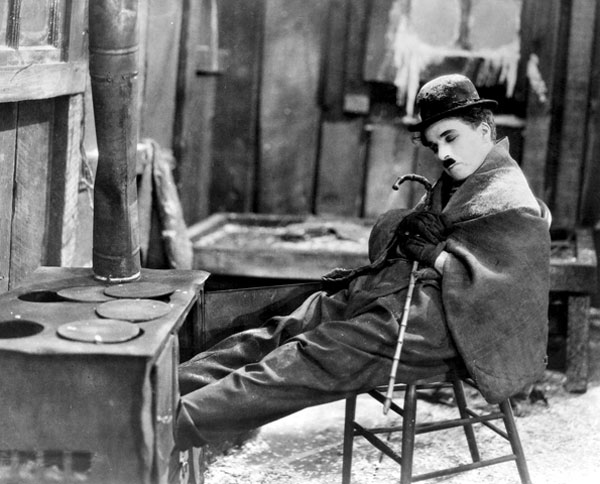
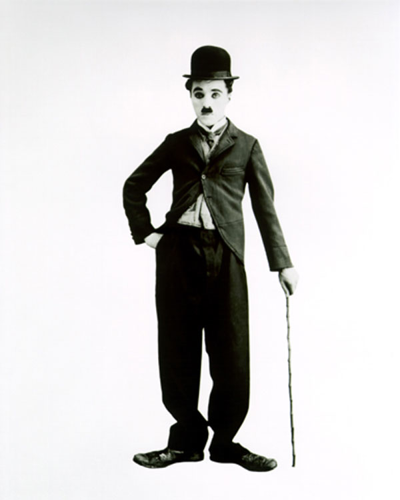
In Bernardo Bertolucci's The Dreamers, two film buffs have a heated argument over the relative merits of Charlie Chaplin versus Buster Keaton. "Keaton is a real filmmaker," says one. "Chaplin, all he cares about is his own performance, his ego!" It's a common knock against Chaplin: that for all the brilliance of his films, there was something fundamentally artless about his direction — that all he needed to do was just turn the camera on, make sure he himself was lit well, and proceed to perform his (admittedly wonderful) shtick.
The charge is, of course, nonsense. One need only check out the Belcourt's new Chaplin retrospective to see that the man's directorial style was profoundly refined, though it may not have relied heavily on montage or technical trickery.
The Chaplin narrative formula was famously simple and effective, and it speaks to part of his talent for connecting with his audience: A down-on-his-luck tramp stumbles into a situation that appears to be well beyond his talents or his station, and chaos (not to mention a healthy dose of pathos) ensues. In The Circus (which kicked off the series on Oct. 30-31), he's mistaken for a thief and winds up inside a circus where he becomes part of the act; in City Lights (which screens Nov. 5-6), he helps out a drunken, suicidal millionaire and winds up becoming the man's partying companion, only to be rebuffed every time the guy sobers up. In The Gold Rush (Nov. 5-7), he's somehow made his way to the Klondike as an inept prospector. Occasionally, the situation is one of the Tramp's own making: In The Kid (Nov. 15-16), he actually plays a con man (albeit a lovable one) who works in tandem with Jackie Coogan's titular tyke.
But despite that simplicity of conception, the actor-director's domineering perfectionism was unmatched. It wasn't until after his death that outtake footage emerged showing how Chaplin would painstakingly work his scenes out on film, sometimes doing more than 100 takes to get everything right, driving his cast and crew crazy in the process. That the work didn't "show" may have contributed to his reputation for artlessness; that the work was there, however, certainly had a hand in his mind-bending success.
"Success" doesn't quite do it justice. Charlie Chaplin was not just the most famous entertainer but the most famous person in the world from the 1910s through the 1930s. Through two depressions, at least two cataclysmic wars, and all the ups and downs in between, he was there. Clearly, there was something more going on.
To understand it, though, we need not look far. The movies are still here, and they still hold a profound power. The Little Tramp, at once hilariously klutzy and devilishly clever, balances our fear of inadequacy with our need for hope. That push-pull tension makes for a magnificently surreal cinematic ballet of pratfalls and close calls. In Chaplin's films a fight can suddenly turn into a dance, a stumble can turn into a jig, a man's near-fall off a ladder can turn into a kind of rhythmic poetry.
But beyond their exquisite choreography and almost musical elegance (when sound came along, the director didn't rush to add dialogue, but he did begin to compose his own scores and fussed over his soundtracks), Chaplin's films adhere to a kind of principle of soul conservation. Even as his characters get subsumed into different identities, their essence rarely changes. Whether pretending to be a boxer or a roller-skating night watchman, a circus performer or a high roller, the Little Tramp is always there, easily picked out by his mustache and his distinctive mopey shuffle. That may seem like an obvious point, but this paradox of identity carries across to Chaplin's other, non-Tramp films and performances as well.
Indeed, his most ambitious work, the 1940 anti-Hitler comedy epic The Great Dictator (Dec. 3-5) is basically a treatise on shifting personae. Chaplin had tried to do away with the Little Tramp character in the '30s, with 1936's dazzling mechanization-run-amok farce Modern Times (Nov. 12-13) marking his official farewell. But when Hitler rose to power, appropriating Chaplin's emblematic mustache into his own iconography, the director-star split his alter ego into light and dark halves, as if to erase any doubts about the difference. Chaplin plays both a kind and heroic Tramp-like Jewish barber and his malevolent double, the delusional dictator of a fictional Germanic country. In the end, the barber, posing as the dictator, has to give a victory speech. He instead uses it to decry militarism and fascism, but as it continues Chaplin sheds both identities and allows his true self to emerge, in one of the most emotionally raw and earnest scenes ever filmed by a major movie star.
For what would be his next, perhaps most notorious film, Chaplin seemed to do away with the Tramp for good. Monsieur Verdoux (Nov. 21-22) is about as far as one can get from the earlier comedies, and yet it too follows a similar (though in this case deeply cynical) pattern of shifting personae. The titular down-on-his-luck bank clerk (played by Chaplin, though with none of his prior ambling charm) woos and marries wealthy widows and murders them — but he does so to help out his wheelchair-bound wife and child. It's a bizarre and brilliant film, alternating between moments of chilly suspense and perverse humor.
It's hard to get a handle on Verdoux. He's kind to animals, dotes upon his family, and displays an ironic brand of mercy — even as he offs and incinerates his victims. Needless to say, the film was savaged by U.S. critics and audiences, who were shocked to see Chaplin playing a monster. But their rage spoke perhaps to the extent of their identification with his characters. How dare the world's greatest Everyman play a murderer — especially one who personifies capitalism carried to its cold-blooded absurdist extreme?
And still the Tramp persisted — sort of. His ghost looms over 1952's Limelight (Nov. 12-14), in which an aging Chaplin plays a drunken has-been comedian who saves suicidal dancer Claire Bloom (again with the suicides!), nurses her back to health, then sacrifices himself for what he believes will be her happiness. If the film doesn't sound very funny, it's not meant to be. Verdoux's cynicism to one side, Chaplin had always had a soft spot for sentiment; of all the great slapstick silent comedians, he was the only one whose films could effectively be categorized as melodramas as much as comedies. The sprawling Limelight features some great gags — including a terrific musical number with Buster Keaton — but it's also steeped in sadness. It moves not with the effervescent, dancerly momentum of Chaplin's earlier works but with a lockstep of impending fate, its portent made almost tactile by Karl Struss's soft-focus, fog-drenched photography.
Limelight feels like a swan song, so it's perhaps ironic that Chaplin continued to work for another decade and lived for another 25 years. (His unfairly reviled 1958 film A King in New York, a surprisingly lighthearted skewering of the country that effectively kicked him out in 1952, screens Nov. 20 and 22.) But in some ways it is a swan song: a final adieu to the identity that he had forged over his stunning career, and a farewell to the inextricable, almost subconscious bond he had with his audience, even when they hated him. It is, perhaps, the final twist in Chaplin's lifelong meditation on identity and essence. When Charlie Chaplin exorcised The Tramp, he effectively did away with himself.
Email art@nashvillescene.com.



