
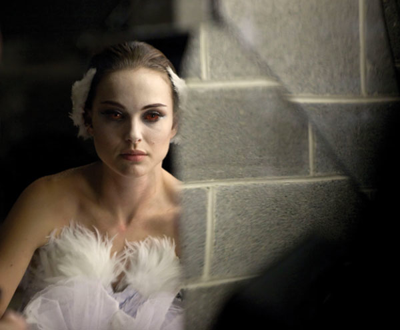

Darren Aronofsky's Black Swan, a sinuous, sexy psychological thriller about a high-strung ballerina (Natalie Portman) pushed to the brink of madness by stress and rivalry, opens Friday as part of a year-end deluge of awards contenders. Sure, we could review it for you — it's alternately silly, scary and transcendently over-the-top — but we were more curious whether there was any truth to the grueling details of mental and physical punishment. We asked past and present members of the Nashville Ballet, who are presenting Nashville's Nutcracker through Dec. 19, to assess everything from the dancing to the portrayals of backstage mania.
What are your first impressions of the movie?
Alexandra Meister: Now everyone's gonna think ballet dancers are crazy. (pause) We are crazy. (laughter) Now everybody else knows.
Kate Kastelnik: I think it was a good backdrop for that exploration of the line between fantasy and reality in someone who is unstable. When someone is doing a role like that, they have to live in it somewhat. You have to go beyond the studio.
Did Natalie Portman do a good job?
Eric Harris: Absolutely.
Kate: Her acting was amazing.
How was her dancing?
Sadie: Well, they only showed her upper body.
Eric: Who knows if it was her dancing or somebody else dancing.
How was her upper body movement?
Sadie: To any dancer, you can tell she's not professional, but I think for any non-dancer, it looked great. She did a good job with it. But at times, it was like, that finger isn't right, or that's not quite it.
Eric: Of course, you're asking a room of dancers to critique a movie that's themed in ballet. (laughter) And they've been doing this for decades. I feel like Benjamin Button [with Cate Blanchett] did a much better job of a non-dancer portraying a dancer. And that wasn't even the primary character. The context and choreography was much better in that movie. This had hardly anything that was true to life. Maybe the backstage aspects of ballet life were more true to life. But I thought it was kind of a lousy representation [of ballet life].
Kate: It was more of a psychological thriller first and foremost, not a dance movie per se.
Kimberly Ratcliffe: Yeah, there wasn't a lot of dancing in it.
Alexandra: I was a little disappointed they didn't use the classical rep of Swan Lake.
Kimberly: It's kind of hard to see it butchered like that.
Alexandra: That's not the order of the music, that's not the choreographer.
Kate: Were they trying to dumb it down to make it more accessible for the non-dancers doing it, or do we think they were reimagining it because it's a film?
Eric: If my husband was here watching that, he'd be so aggravated and annoyed, because he'd be like, "This is so gross."
Kate: He's very educated in dance, and he's seen [Swan Lake].
Sadie: The general population isn't going to care. That's not the point of the movie.
There was a scene with four dancers where you all moaned and groaned.
Chris Butler: That was the four cygnets, and that's an iconic scene.
Eric: Those four dancers dancing together have defined ballet in film and commercials. Everything we ever see on TV of ballet is that. And they didn't even do that in the context that it was meant. Every person on the planet recognizes that choreography and they didn't use it.
Chris: I wouldn't be surprised in the least to find some non-dancers watching that and thinking, "That doesn't look right." That, actually, I was a little disappointed in.
Eric: But it was an opportunity for a choreographer to create their own work for the movies.
Sadie: Yeah, but anything but Swan Lake. Just don't mess with Swan Lake! (laughter)
Judson Veach: The music sounded really good though. (Everyone agrees)
Kimberly: That was my favorite part of the film, all the different interpretations of the music.
Chris: I also liked the use of the mirrors. The mirrors are just everywhere. The first time you see (Portman's) opposite, the Black Swan, in the movie, you see her through glass in the subway car. The first time the White Swan sees the Black Swan in the ballet is in the third act, in the mirror.
Eric: Your best friend and your worst enemy are the same person, looking back at you.
Chris: And the conclusion you draw from that is that we're all just ego-driven narcissists who stare at themselves in the mirror.
Kate: But the mirror itself can warp reality, as we all know. This is a deeper exploration of the warping of the line between fantasy and reality.
(The dancers ooh and aah at Kate's pithy observation.)
Kimberly: Dancers are not that mean to each other. We're all like a family. There's no writing of "whore" across the mirror.
Eric: It never happens that there's one ballerina who does the role, so it was kind of an unrealistic scenario in the first place. In each given show, one ballerina will do both [the Black Swan and the White Swan roles], but it's going to be shared by three to five to 10 ballerinas, depending on how big the company is.
Kate: One girl couldn't handle doing both roles at like 30 shows. There's no way. Your body wouldn't be able to handle it. You'd take a piece of glass and stab yourself. (Laughter)
How did you feel about how the persona of the ballet dancer was presented?
Chris: It's an accurate characterization of one kind of dancer. I've definitely been around dancers that were like that, who were very pushed by their stage parents, coddled, neurotic.
You've all been around them, but none of you are them.
(Laughter)
Eric: I think that everybody who's given that opportunity to take on that role of a lifetime, they've definitely entertained that place where they're deciding whether or not to let themselves go beyond sanity into crazy. Sometimes you feel you have to do that. I don't know if it's necessarily true, but it's definitely a lure. You look at your role models and hear all sorts of crazy stories from people like Gelsey Kirkland. Dancing on My Grave was her autobiography. Lots of craziness was exposed in that book about how she approached her roles. And she was consummate in her roles. So you question, "Do I have to go that far to be able to portray what I need to portray to the audience? Or can I just be a normal human being in the moment and just play my part?"
Sadie: You have to do both. I've struggled with being consumed by roles. Especially ballets that you die in! This is my fourth ballet that I've had to die in now, and that really takes it out of you! It's tough when you go through that every day and figure out how you want to say that to the audience. But at the same time you have to go home at the end of the day and be a human. You have to be healthy. You have to eat. You have to take care of yourself or you couldn't do the role. You can't attain that perfection if you're obsessed with it.
Eric: I was interested by the whole exploration of the ballerina who can't let go. I think that by and large the ultimate problem with the young artists of today is that they're so well-disciplined and so regimented and so sheltered that they really do have to fight with that problem of letting go of the wholesomeness of the ballerina.
Kimberly: That's true with some dancers, but I see other young ones that are kind of the opposite, that are not focused.
Eric: Well they're not going to get that part. (laughter) Everything that's expected of you as an artist to get to that level — everything you have to give up, everything you have to not have, everything you have to not experience in order to be at the level at that point in your life — means that you haven't the foggiest clue what it means to be seductive. That was a very realistic portrayal. What's funny is that choreographers value the artist that is, "My life is the ballet, and everything I do is preparing for this," yet they want you to be so raw, and so spirited and so unique. You can't be both, honestly.
Kimberly: But Balanchine used to tell his dancers to go to the art museums, and to go out and have a good time. He wanted them focused, and he was very controlling too.
What do you think of the Vincent Cassel character?
Chris: He was very over-the-top.
Kimberly: Some of that was pretty silly. Like the speech during class.
Sadie: That's not what Paul [Vasterling] is like it all. That's a combination of every story you've heard about every evil director combined. Now that was a sexual harassment lawsuit waiting to happen.
How realistic was the portrayal of the physical tortures of ballet?
Sadie: Totally true. (everyone agrees) That was my toe. I had a toe issue during Swan Lake that was very similar to that. That was all pretty accurate. It is that hard on your body.
Kimberly: I liked the foley artist, all the cracking and sounds.
Chris: I appreciated the attention to daily details, like the ritual of the point shoe.
Sadie: They were tied correctly.
So they got those details right?
Eric: Musically more than anything. Musically they had all of their cues right.
Did you enjoy the movie?
(Everyone agrees the movie was enjoyable.)
Eric: I wouldn't approach it as a film for ballet. I would approach it strictly as a suspense thriller.
Alexandra: However, I do think it's good that they're mainstreaming ballet, because it's a dying art form, because no one "gets it." So it's a start.
Judson: I think when you take it to the extremes this movie took it to, you don't see all of the positive things in ballet. I feel like 90 percent of my day is positive, good things.
Kimberly: Even the sense of humor that everyone has at the studio. We're cracking each other up all day.
Eric: I lot of the film was clichés that we all make fun of every single day. I don't know if you noticed, but we were all like, wink-wink, nod-nod, laughing our ass off during a really dramatic moment, because we joke about this all the time. And it's because it has a root in reality — but we all are like, "Oh, that's not me."



