

We appear to be in a new era of cinematic satires — written by, directed by and starring Black folks — that take aim at white people’s general perception of African Americans while also telling stories about African Americans that are sympathetic and free of stereotypes.
Writer-director Cord Jefferson’s debut American Fiction received five Oscar nods — including Best Picture — for its tale of a frustrated Black author (Jeffrey Wright) who becomes a star among white readers after penning a fraudulent ’hood memoir. And now we have The American Society of Magical Negroes, which finally sends up the cinematic device/cliché that white critic Matt Zoller Seitz once described as “a glorified walk-on role, a narrative device with a pulse” and “a glorified hood ornament attached to the end of a car that’s being driven by white society, vigorously turning a little steering wheel that’s not attached to anything.”
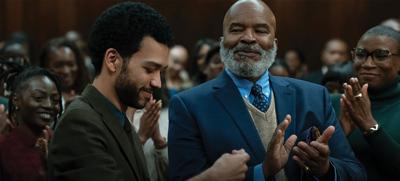
Struggling yarn artist Aren (Justice Smith) becomes a member of the titular society after being recruited by longtime member Roger (David Alan Grier). Aren learns that magical negroes have been around for a long time, keeping white folks’ fear of a Black planet at bay by helping them succeed — whether it’s giving a frustrated athlete tips on how to excel at a sport or getting rid of a prison guard’s painful urinary infection. (Sound familiar?)
Aren’s first assignment has him serving as the wisdom-spewing work buddy to a clueless, privileged white guy (Drew Tarver) at a supposedly hipstery tech company. Aren also develops a crush on a female co-worker (An-Li Bogan, looking like Patti Harrison here). Unfortunately, since the white dude is sweet on the co-worker too, Aren has to hide his feelings and play that other insufferable cinematic trope: the Black best friend.
When it comes to bringing the satirical pain, Negroes has even less bite than the ultimately softhearted Fiction. Actor/Yale graduate Kobi Libii pulls a lot of punches in his debut as a writer/producer/director. The whole magical-negro element (the society chambers — secretly hidden behind a barbershop but somehow stationed next to Thomas Jefferson’s Monticello — look like Hogwarts if it were populated by people who use shea butter, with Nicole Byer adding a couple chuckles as the floating leader) becomes less integral as the movie wears on. Libii seems more concerned with giving us a romantic dramedy in which the two young, attractive leads — despite having off-the-charts chemistry — are presumably doomed to never hook up.
Although he essentially made a film about how Black people are tired of having to calm white people’s nerves all the damn time, it seems Libii isn’t out to make Negroes uncomfortable for audiences. He takes white people to task for being clueless when it comes to diversity (and that also goes for people in the film industry, who have been giving white people sage, harmless Black pals since Uncle Remus first sang “Zip-a-Dee-Doo-Dah” in the disgraced Disney movie Song of the South), but he doesn’t go about scorching the earth.
He gives both Smith and Grier emotional, Black-lives-definitely-matter monologues for certain scenes — reminders to white audiences that Black people are just as afraid of them as they are of us. The always reliable Grier serves as a stern but supportive mentor, but the lanky, biracial Smith seems miscast. Although he displays some determined vigor as a fed-up Black dude, I had trouble seeing him as someone who could make white people uneasy. (A bulky but charming brotha like Aldis Hodge or Yahya Abdul-Mateen II could’ve easily made this work.)
Light on snarl and heavy on sentimentality, The American Society of Magical Negroes fails to be the nail that finally seals the magical-negro coffin. Instead it’s the most twee fuck-you to racist white people since Disney hired Halle Bailey to play Ariel in its Little Mermaid remake.



Post a comment as anonymous
Report
Watch this discussion.
(0) comments
Welcome to the discussion.
Log In
Welcome to the discussion.
Keep it clean. Please avoid obscene, vulgar, lewd, racist or otherwise abusive language. Comments featuring hate speech or threatening or violent content will not be tolerated.
PLEASE TURN OFF YOUR CAPS LOCK.
Be truthful. Don't knowingly lie or mislead.
Be proactive. Use the “report” link on any comment that violates our comment policy.
Share with us. We'd love to hear your feedback.