
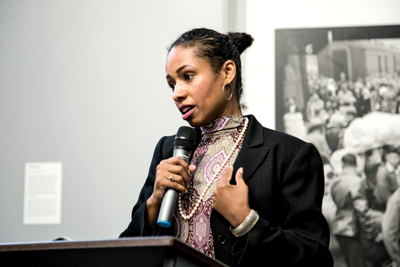


A little more than two years ago, Larycia Hawkins was at the center of controversy at Wheaton College — an evangelical Christian university located about 45 minutes west of Chicago.
Hawkins, the first black woman to obtain tenure at the college, decided to don a hijab in solidarity with Muslim women. The move caused an uproar at Wheaton: Some alumni, parents of students and administrators at the college saw it as blasphemous. In a Facebook post about wearing the hijab, Hawkins said Muslims and Christians worship the same God. She was forced out of her job on campus. She tells the Scene it was the first decision she’d ever made that she knew immediately was the right thing to do.
“I have no regrets,” says Hawkins by phone from Charlottesville, Va., where she now teaches at the University of Virginia. “I would do it again and again and again.”
Can you talk a bit about the idea of embodied solidarity?
I think that what inspired [the term] ‘embodied solidarity’ was Jesus’ life and the way that Jesus embodied a kind of radical alt-spirituality that was political. So for me, when I think about the prophetic books of scripture, what’s clear is that you can’t say you’re righteous unless you’re also living and embodying justice. And I think if we look back at prophets of scripture — contemporary prophets like MLK, Gandhi, Malcolm X, Dorothy Day ... Ella Baker — I think we can’t talk about contemporary prophets without also realizing that it wasn’t just that they spoke truth to power, they put their bodies in proximity in the places of the greatest injustice in the world. They didn’t just find themselves there — just like Jesus didn’t just find himself in Samaria. Jesus purposely walked through Samaria, where no self-respecting Jew would be seen.
Trump has been president a little bit more than a year, and I think a lot of people have been waiting for white evangelicals to denounce him.
I think about the Trump-white-evangelical phenomenon from a lot of angles, because I’m a political scientist who’s a Christian, and it’s quite difficult for me as a Christian to understand and embrace policy positions that are so diametrically opposed to everything the scripture says about supporting the vulnerable. And I want to be clear that policy tools are different than policy priorities. So I’m not [saying] I think all Republicans’ tools are bad, or all Democrats’ tools are bad, or all on one side is bad because Trump is president. ... I can’t explain it on a level of embodied solidarity, because Trump exudes the opposite of solidarity. As a political scientist, I can explain it. I think there are plenty of people in white evangelicalism for whom Christianity and capitalism are joined at the hip. Ergo, they would elect anyone, and I mean anyone, who props up their economic interests. … I think it’s quite strange that Trump [doesn’t support vulnerable people], and doesn’t ask for forgiveness, because he doesn’t think he needs it. He’s the anointed one for the moment.
Belmont is majority white, as are most Christian universities. How do you go about speaking to those audiences? Is white evangelical responsibility something you try to broach when you’re speaking?
Yes, I’m always aware of my audience, but I think the message of embodied solidarity doesn’t change. I think that the call for our time is, again, to be in embodied solidarity with others. It’s a risky call, because I think we’re called to risk our lives, to be willing at least, for the vulnerable, standing up for justice in public ways and private spheres. It can be dangerous. You think about most of our American prophets — many of them lose their lives because their fight for solidarity took a toll on their body, or they’re assassinated for the kinds of things they do and the things they say and the kinds of responses they arouse. … I try to, when I’m in the midst of college students, remind them of their privilege, but also remind them not to be paralyzed by it. Whatever position they find themselves in in life, to use their relative privilege on behalf of the most vulnerable. What I mean by ‘on behalf of’ is amplifying the voices, amplifying the bodies, putting them in a position to speak for themselves. I’m not saying doing for, I’m saying doing with, and in some cases decreasing so those voices can increase. In fact, perhaps, disinvesting in one’s privilege and investing it in others. I think those are the kinds of things that resonate with me when I’m speaking to people at a place like Belmont.
You’re in Charlottesville now. How has the faith community handled the aftermath of the Unite the Right rally?
The response was in large part organized by people of faith. And I think it’s amazing on one level that those on the front lines in the pictures you see Cornel West, Rev. Sekou. The people who people didn’t know who they were — kind of the majority white faces [were] religious organizers and local congregants. They come from a plethora of churches: kind of mainline protestants, some white evangelicals, some from black churches. And the reality is that there was a vast underground network organizing the resistance in Charlottesville. The preponderance of folks involved were Black Lives Matter and religious [people] and elements of [the anti-fascist movement] Antifa. I think it’s important for people to know that always when you’re talking about an organized resistance, it’s really often full of strange bedfellows.



