
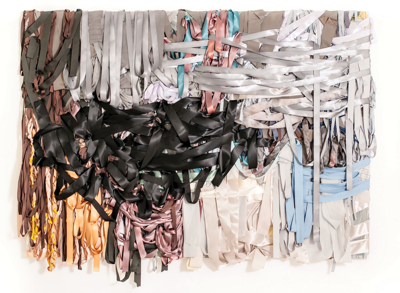


"Storm System"
No one, especially not Vadis Turner, thought moving from New York to Nashville would be just the thing to jump-start an art career. But here we are, weeks after Turner’s first solo museum exhibit, Tempest, opened at the Frist, and less than a month after The New York Times profiled the artist in a photo-heavy feature. The show is filled with large-scale works that Turner describes as paintings, but that use ribbons in place of brushstrokes, quilts instead of canvases, and found objects, ephemera and even her own breast milk in place of more traditional media. Tempest is divided into three galleries, each of which represents a time period in the lives of women — there’s the “Wild Woman,” the “Mother” and the “Elder.”
In a conversation with the Scene, Turner recently discussed how her work has been shaped by the move back to her hometown, and how that — as well as her subsequent reconnection with family — has put her in line with a long tradition of feminine archetypes.
When you were making the works in the “Wild Women” section, you have specific people in mind — women like Eve and Hamlet’s Ophelia. It’s interesting to me that you are making work about being a woman, but it seems like you’re trying to make sure it’s not autobiographical. Is that important to you? Well, yes and no — in the “Mother” room it did become about me. That was the first time I ever put myself in the character, which was really hard. It was about something much bigger than me, too — it was definitely me connecting with that cycle. I made it when I was pregnant. It’s very much about pregnancy and birth, and I finished it after [my son] Vreeland was born.
You’ve spoken about how wanting to make work about the stages of womanhood and femininity has coincided with you realizing that you were going to be the mother of two boys, and that you weren’t going to have daughters. Or any more kids in general. And I also, just to be honest, found myself embarrassed making the work. I think it just took me a while to figure out how to do it and how I felt about it, and saying, “This is enough, and this is worth it.” As a female artist you kind of want to not do that — not do the birth artwork. I just feel like it could go wrong and be unappealing and too obvious to do. So I struggled with that. I knew I needed to do it, and I knew it was important enough, but now I have to stand by it and say, “This is actually about me, and I’m putting myself in here and I have to own this story,” instead of just taking on other people’s stories and sort of riffing or elaborating, which is really stimulating, but I had already done that. It was time to change course.
So you moved back home. I didn’t move here for my art career, but it was the best thing I could have ever done — for the work, and for professional opportunities that I’ve had. It has delighted and shocked me how brilliant it was to move to Nashville to be an artist, and I didn’t see that coming, but I’m so thankful. [In New York] I was trying to make works about storm systems in a studio that didn’t have a window. I was, like, looking up storms on YouTube. That’s not how I want to live or work. It’s crazy.
Where was your studio at that point? It was in Williamsburg [Brooklyn]. It was tiny, and it was expensive. I couldn’t even fit myself and those pieces in there, let alone get them out. It was just fraught with logistical problems. … [Now] I’m working at my grandparents’ house, which has windows on a lake, and I can actually witness and be part of the storms coming in. This is my environment, and I can really turn these feminine materials into storm systems and different phases of storms.
At the media preview for Tempest you spoke about the connections you saw with the artists whose work was in the other Frist exhibit [State of the Art: Discovering American Art Now]. It was blowing my mind in there!
It’s like you and these other artists all have antennae tuned to the same frequency, and it’s just right. And that we’re all responding to the same stimuli. We’re all part of the same culture — there are different variations depending on where you live and how you live, but we’re all responding to the same stimuli. It’s really cool to see how other artists are doing it. I think that show is dynamite, and I’m so thankful to be in the same company. I mean, I think the Frist Center is killing it. It’s a really good art summer, so I’m just happy to be at the party.



Post a comment as anonymous
Report
Watch this discussion.
(0) comments
Welcome to the discussion.
Log In
Welcome to the discussion.
Keep it clean. Please avoid obscene, vulgar, lewd, racist or otherwise abusive language. Comments featuring hate speech or threatening or violent content will not be tolerated.
PLEASE TURN OFF YOUR CAPS LOCK.
Be truthful. Don't knowingly lie or mislead.
Be proactive. Use the “report” link on any comment that violates our comment policy.
Share with us. We'd love to hear your feedback.