
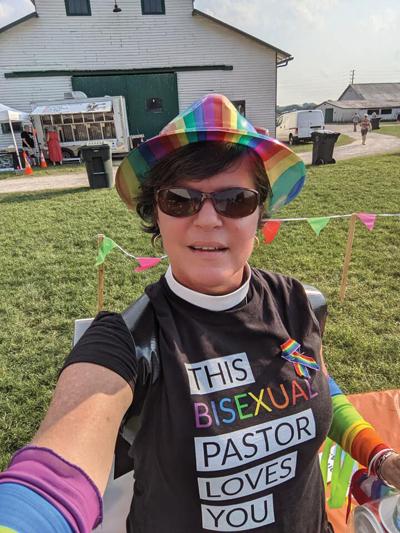


The Rev. Dawn Bennett
The Rev. Dawn Bennett is looking forward to serving communion at Nashville Pride for the first time this year. It’s a chance to look people in the eye and affirm them, she says.
The former pastor of The Table — which bills itself as the city’s only LGBTQ-centric church — moved to Murfreesboro to lead a church there after The Table closed abruptly in October 2024.
“To be able to serve communion at Pride, especially to folks who have not found their way back to an affirming church and who still want to … it’s a very healing thing to say, ‘God does see you and God does love you, and you are welcome at this table,’” Bennett says.
Bennett has long been behind Pride Spirituality Night — which includes a range of faiths and most recently took place on June 24 at the Scarritt Bennett Center — and will also be accepting the Nashville Pride Community Service Award on Saturday. Communion will take place at the booth of the newly formed Lay Leadership Collaborative of Middle Tennessee — ELCA (Evangelical Lutheran Church in America), who will be joined by affirming pastors across the city to march in Saturday’s parade.
“I think that that’s a huge misunderstanding — that gay people don’t have a very life-nourishing faith, and they do,” Bennett tells the Scene. “Clearly there’s a lot of hurt, and it’s caused by the church. I am not shy to admit that, but because of that, it’s the church’s responsibility to repair the breach.”
Lutheran churches like the one Bennett leads officially show support for LGBTQ people by earning a Reconciliation in Christ designation. This requires adopting a statement denouncing racism, a land acknowledgement and a statement welcoming LGBTQ people. First Lutheran Church ELCA in downtown Nashville earned its designation in December, but each denomination does things differently.
Christopher Flor, president of the First Lutheran Church ELCA and co-founder of the Lay Leadership Collaborative, has a “God-sized dream” — that all of the congregations will work together to find a uniform way to show support for the LGBTQ community.
“A queer person walking through Pride and seeing churches there can counter a massive amount of trauma that they’ve been through,” Flor tells the Scene.
Some churches welcome women and LGBTQ people into the pews, but not into the pulpit. It’s an issue that divided the Lutheran church in 2009, and the United Methodist Church in 2023. As a bisexual woman, Bennett is doubly in the minority. She says she’s been criticized publicly, spat upon and has even received death threats.
“It’s a constellation of beautifully complex truths, and I realize that not everybody is happy that I’m here, but God is happy, and that’s really all that matters to me,” she says. “I am of the mind that there’s enough God for everybody in the world, no matter how you call God, how you get to God, how you allow God to get to you.”
Flor says there are a handful of “clobber” passages in the Bible — scripture that some Christians use to “create a wholesale defense of the exclusion and marginalization of queer people.”
“The prevailing understanding is that churches are not inclusive, that the Bible emphatically and categorically condemns queer love, when it actually doesn’t discuss queer love in detail,” he says. “There’s hundreds of scriptures on inclusion and love and welcome and God’s radical justice and mercy — and the actual case for an anti-inclusive theology, in comparison, feels limited to me.”
At the end of her recently published book, A Seat at the Table: Stories of Faith, Healing and Rebirth, Bennett challenges people to take what The Table’s members learned in the church’s five years and plant seeds in new places. Flor was one of those members.
In the past decade or so, Bennett has observed an increasing number of pastors beginning to unpack the hurt the church has caused LGBTQ people. She believes part of her call is to work with pastors and parents who don’t yet affirm LGBTQ people “in a way that helps them begin to understand in God’s design diversity is all over the world — why would we think that God stops being diverse and creative when it comes to humans?”
She considers those who are not yet affirming “poor in spirit” — a group of people the Bible calls her to care for.
“Pride is an opportunity, especially for people of faith,” Bennett says. “When you can put those two things in the same sentence and celebrate yourself and celebrate your neighbor — it’s just magical.”

Talking to The Cowgays, profiling the city’s queer Christian leaders, highlighting the best of Nashville Pride and more



Post a comment as anonymous
Report
Watch this discussion.
(0) comments
Welcome to the discussion.
Log In
Welcome to the discussion.
Keep it clean. Please avoid obscene, vulgar, lewd, racist or otherwise abusive language. Comments featuring hate speech or threatening or violent content will not be tolerated.
PLEASE TURN OFF YOUR CAPS LOCK.
Be truthful. Don't knowingly lie or mislead.
Be proactive. Use the “report” link on any comment that violates our comment policy.
Share with us. We'd love to hear your feedback.