

Criminal Court Clerk Howard Gentry wonders if he was the first Black boy to swim in the pool that was once at Centennial Park. He remembers jumping the fence after hours on at least one occasion.
In 1961, when Gentry was 9, civil rights leaders Kwame Lillard and Matthew Walker sought to integrate the pool but were barred from admission. The story of access to pools in Nashville is incomplete without noting when, following their attempts, the city closed all of its 22 pools — 15 for white people, seven for Black people — rather than integrate them. Gentry and much of Nashville’s Black community were forced to migrate to Tennessee State University’s pool, a safe place that Gentry remembers accommodating the larger crowd. Meanwhile, white families flocked to private swim clubs.
While the rest of the city’s pools reopened in 1963, Centennial Park’s pool never did. Nashvilians can pay to access the YMCA pools or a number of private pools, but many of the city’s original pools were permanently closed in the years following integration. Nashville is left with six indoor and four outdoor pools managed by Metro Parks and Recreation and a city population that has quadrupled in size since the 1960s.

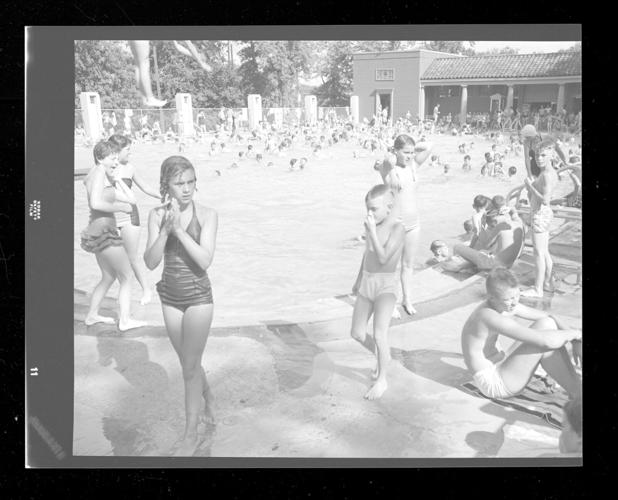
Centennial Park pool, 1955
Longtime local swim instructor Emily Khan notes not only the dearth of pool space but also the lack of quality lessons and lifeguards in Nashville. By February, slots for her summer backyard swim instruction were filled. She teaches 95 children per week, with 30 more on the wait list.
Drowning is the number one cause of death for children ages 1 to 4, and 55 percent of U.S adults have never taken a swim lesson, according to 2024 data from the Centers for Disease Control and Prevention. About half of white adults have had swim lessons, whereas only about 1 in 3 Black adults and 1 in 4 Hispanic adults report having taken a swim lesson.
That’s why Khan started parent and child swim lessons, and lessons in Spanish. Khan also facilitates swim clubs at some area high schools and middle schools that don’t have sanctioned swim teams through her nonprofit Nashville School Swim Club. Even at diverse schools like Isaac Litton Middle School and Stratford High, the majority of her team is white.
Khan says she’s lucky to have access to two lanes at Margaret Maddox YMCA in East Nashville — she made a deal that if she could use the lanes, she’d make sure they have lifeguard staff.
“I don’t know what the solution is,” Khan says. “I can point to all the problems, but I’ve built my own little niche in my neighborhood and become a pillar of the community. … It’s been absolutely fantastic for me, but I have no ambition to get any bigger than what I am.”

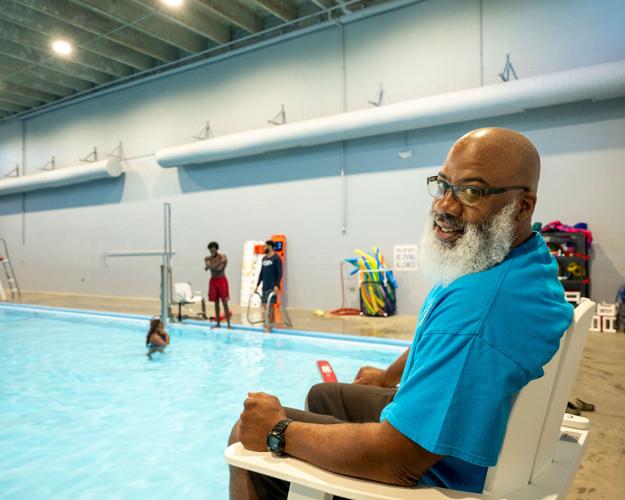
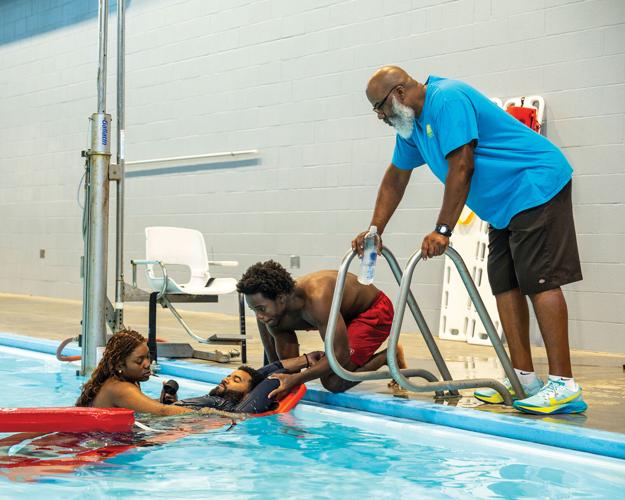
Antwan Majors teaches a lifeguard program at Centennial Sportsplex
Antwan Majors, special program coordinator at Napier Community Center, started a lifeguard program in 2023 that pays teens to train in an eight-week course. He’s also planning to offer swim lessons this year for the lowest price yet — $10, with the help of grant funding. Lessons are also offered at Centennial Sportsplex through the SwimAmerica program, which offers sliding-scale pricing. The typical $60 fee at Napier is high, Majors notes, especially for families with multiple children.
It can be difficult to get parents to commit, especially with the additional upkeep required for Black children with natural hair, Majors says — but he sneaks in a bit of swim instruction on typical days at the pool. The kids want to play with the kickboards, and he teaches them how to use them first.
“I have games and stuff I play with the kids, but it’s all still teaching,” Majors says. “We teach them when we can without the group, without the sign-up. We’ll just keep them coming that way.”
Majors says he sees the fallout of a lack of pool access for the Black community. Even when the pools were integrated, learning to swim was often cost-prohibitive.
“It’s almost like going to the water is taboo,” he says. “If your parents didn’t swim and never took you around the water, how likely are you to swim?”
Despite the additional barriers, Gentry’s father was a swim coach at TSU and Gentry himself went on to work as a lifeguard at Hadley Park and Rose Park, starting at age 15.
“Everywhere we went, swimming was a big part of it,” Gentry says. “Everybody said that Black folk didn’t know how to swim, but a lot of us did.”
Metro Parks swimming pools
Indoor (year-round, free admission):
Coleman Regional Center (384 Thompson Lane)
East Park Community Center (600 Woodland St.)
Hadley Park Community Center (1037 28th Ave. N.)
Hartman Park Community Center (2801 Tucker Road)
Indoor (summer only, free admission):
Napier Community Center (73 Fairfield St.)
Summer outdoor pools (free admission):
Cleveland Park Community Center (610 Vernon Winfrey Ave.)
Looby Community Center (2301 Metro Center Blvd.)
Easley Center at Rose Park (1000 Edgehill Ave.)
Summer outdoor pools (with admission):
Centennial Sportsplex (222 25th Ave. N.): $9 for children and $10 for adults
Wave Country (2320 Two Rivers Parkway): $10 for children and $12 for adults

Swimming, caving, skating, baseball and other ways to spend your summer



