
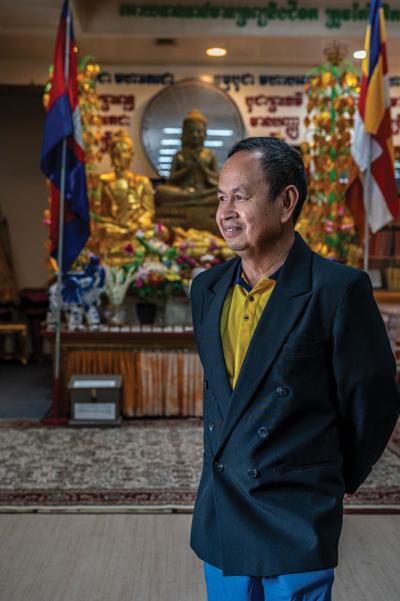


Sony Sok
Sony Sok was 13 years old when he stepped off the plane from L.A. to Nashville in October 1981. “It was the coldest day I’ve ever seen,” he recalls. He soon settled in East Nashville with his mother and four of his siblings. Two other siblings went to Australia. His father, a grocer and durian farmer, did not survive the Khmer Rouge regime.
Sok was in kindergarten in Pailin, a province in western Cambodia, when the Khmer Rouge took over his country. But he does not linger on losses. He tells his life story as a gratitude list of supportive allies and opportunities seized: English classes at Khao I Dang refugee camp; United States Catholic Conference caseworkers who found his family a place to live and registered him in sixth grade; two ESL teachers at Cameron Middle School who helped him adjust to American life; and a YMCA director named J. Lawrence, who ran sports leagues for Cambodian kids and took Sok under his wing, connecting him with a scholarship to Cumberland University. Lawrence also hired him to translate for other Khmers, whom he helped with doctor visits or legal problems. Without the Y, Sok says, “I wouldn’t be who I am today.”
Who he is today is a husband and proud father of two grown daughters, as well as a cheerful jokester who “can’t stay still.” He works as a warehouse supervisor at Wilson Sporting Goods and a pharmacy tech in Franklin. In his spare time, he makes old cars run like new. He attends the Belmont Baptist Church and the Cambodian Buddhist Temple, where he helps with landscaping and preparing for big celebrations like Khmer New Year every April. Sok sees the two faiths as entirely compatible: "Either Jesus or Buddha, if you compare them, they are the same,” he says. Both offer “life lessons, peace, a better understanding of yourself and other people.”
Fifty years after Cambodia’s nightmare began, Sok sees Nashville’s small Khmer diaspora as a success story of transcending hardship and enduring as a community. “We are strong, and we are brilliant,” he says, laughing. “We are hard workers. We are together, work[ing] as a team.”
When I ask him what he’d like to tell his fellow Nashvillians, he says, “I want my voice to be heard, so they know we are here.” Then he grins and adds, “Buy me a large pizza with everything.”

Stories of who these Nashvillians were, who they are now, and who they’re still becoming



Post a comment as anonymous
Report
Watch this discussion.
(0) comments
Welcome to the discussion.
Log In
Welcome to the discussion.
Keep it clean. Please avoid obscene, vulgar, lewd, racist or otherwise abusive language. Comments featuring hate speech or threatening or violent content will not be tolerated.
PLEASE TURN OFF YOUR CAPS LOCK.
Be truthful. Don't knowingly lie or mislead.
Be proactive. Use the “report” link on any comment that violates our comment policy.
Share with us. We'd love to hear your feedback.